
E20 and the Indian Economy: The Hidden Cost of Turning Food into Fuel
“The more important question is at what cost to the public it is achieved.”
India’s ethanol-blending programme has emerged as one of the country’s most ambitious energy-policy initiatives. What began as an experiment in the early 2000s has now become a serious effort to reduce dependence on imported petroleum and has rapidly transformed into a large agricultural and industrial programme. Ethanol blending in petrol increased from less than 1.5% in 2013–14 to 20% in 2025–26, five years ahead of the original target. Ethanol procurement by oil marketing companies is projected to exceed 1,200 crore litres in 2025–26, compared to just 38 crore litres in 2013–14.
The government sees E20 (petrol containing up to 20% ethanol) as an important tool for reducing crude-oil imports, improving energy security, creating a market for farmers and supporting the domestic biofuel industry. The government had estimated that achieving 20% blending would require about 1,050 crore litres of ethanol for 2025-26, and its earlier roadmap estimated annual foreign-exchange savings of about US$4 billion, a carbon dioxide emission decrease amounting to 544 lakh metric tonnes alongside displacing roughly 181 lakh metric tonnes of imported crude oil from a successful E20 programme.
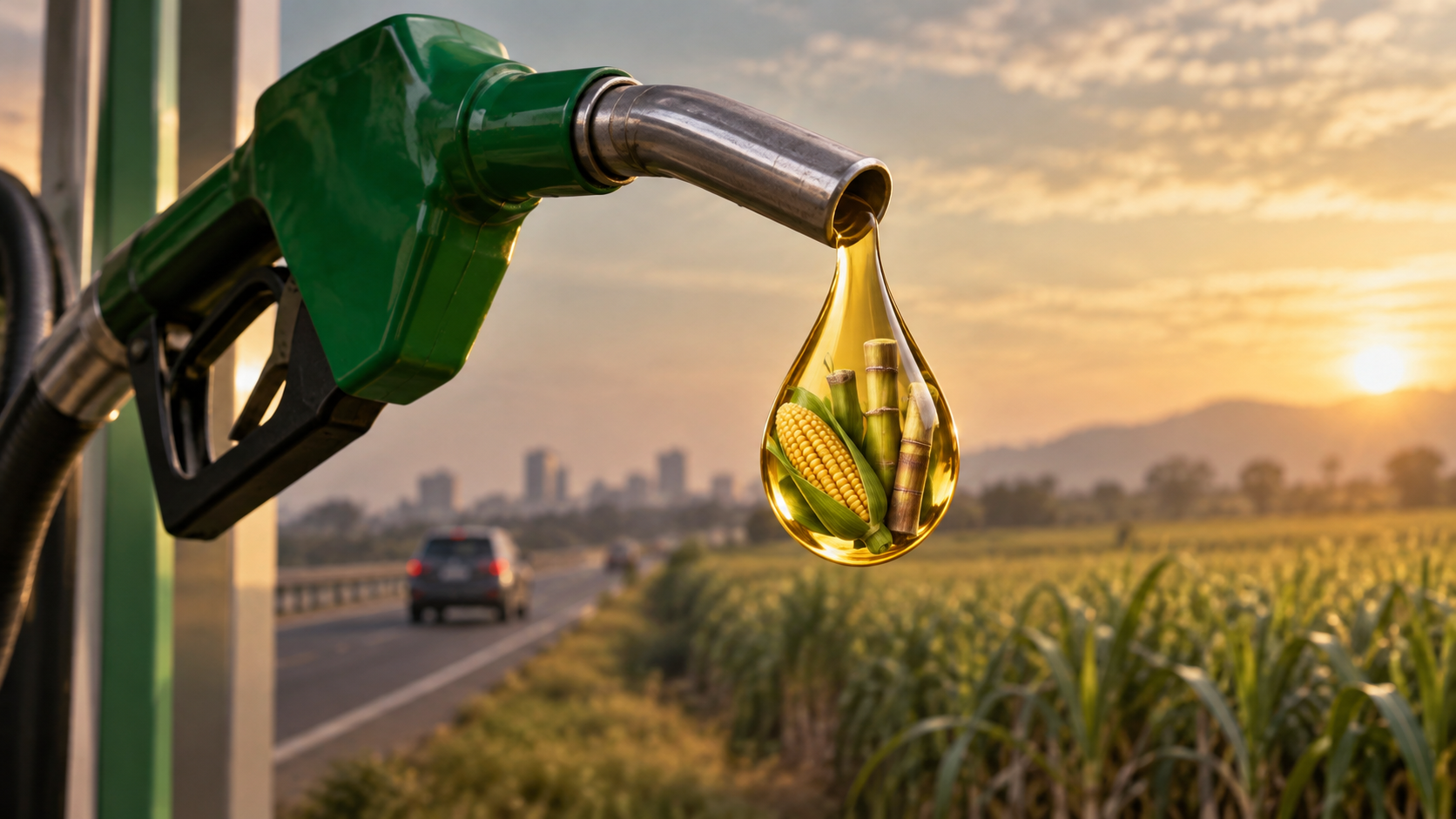
Yet the rapid expansion of ethanol has created a new economic question. Much of India’s ethanol is produced from agricultural commodities such as sugarcane, molasses, maize and rice. As demand for ethanol grows, these commodities increasingly have to be divided between fuel, food, animal feed and industrial uses. The question, therefore, is no longer simply whether ethanol can reduce India’s oil-import bill. It is whether the benefits of replacing imported petroleum are large enough to offset the economic and inflationary costs of diverting agricultural resources towards fuel.
From an oil policy to an agricultural policy
The scale of India’s ethanol programme has gone through tremendous changes in the last decade. According to the Department of Food and Public Distribution, ethanol supplied to oil marketing companies rose from 38 crore litres in 2013–14 to 1,200 crore litres in 2025–26, while the blending rate increased from 1.53% to 20% over the same period. This expansion has required India to dramatically increase ethanol-production capacity. The country’s ethanol production capacity reached 1,953 crore litres as of October 30, 2025, compared with less than 200 crore litres before 2014, according to the Department of Food and Public Distribution.
The government has also deliberately broadened the feedstock base. Ethanol can now be produced from sugarcane juice, various forms of molasses, maize, surplus rice and other grain-based sources. At present India’s ethanol-production capacity is 1,648 crore litres, of which 815 crore litres was molasses-based and 707 crore litres grain-based.
This diversification helps solve one problem – ensuring sufficient ethanol but creates another: competition for agricultural commodities.
The sugarcane trade-off
The sugar industry is one of the biggest beneficiaries of the ethanol programme. India’s sugar mills have historically faced a recurring problem of excess production, large inventories and delayed payments to sugarcane farmers. Diverting some sugarcane-derived material towards ethanol provides mills with another revenue stream and can reduce surplus sugar.
The government has actively encouraged such diversion. The Department of Food and Public Distribution reports that 43 lakh tonnes of sugar was diverted towards producing ethanol in 2022–23, followed by 24 lakh tonnes in 2023–24, 34 lakh tonnes in 2024–25 and 30 lakh tonnes in 2025-26. This can be beneficial when sugar production is abundant. Instead of flooding the domestic market with surplus sugar, mills can sell the feedstock to ethanol producers.
But the same mechanism backfires when sugar supplies are tight.
Every tonne of sugarcane diverted towards ethanol represents agricultural output that is not being used to produce sugar. Consequently, the economic value of ethanol cannot be assessed only by looking at the price paid to the distillery. It must also account for the opportunity cost of the sugar that could have been produced.
This trade-off has become increasingly visible. A recent Indian Council for Research on International Economic Relations (ICRIER) analysis noted that India’s ethanol demand has been growing substantially faster than the agricultural commodities used to produce it. Between 2019–20 and 2025–26, ethanol supplied to oil marketing companies grew at approximately 38% annually, while maize production grew at 11.4%, sugarcane at 5.1% and rice at 4.4%.
That widening gap raises concerns about whether agricultural production can keep pace with the rapidly expanding fuel market.
Maize: the emerging food-versus-fuel battleground
If sugar represents the traditional ethanol debate, maize may become its most important new front. Maize is used not only for ethanol but also for poultry and livestock feed, food processing and industrial products. Therefore, increased demand from distilleries can affect several industries simultaneously. The problem is particularly significant for poultry. Maize constitutes around 55–65% of broiler feed, according to recent analysis of India’s livestock sector.
The potential chain reaction is straightforward:
More maize used for ethanol → less maize available for feed → higher maize prices → higher poultry-feed costs → higher cost of producing eggs and chicken → higher consumer prices.
While this does not mean that ethanol is responsible for every increase in egg, chicken or maize prices, it certainly adds another significant source of demand. According to the National Egg Co-ordination Committee (NECC) egg prices have increased by around 35% to 40% over the past year and are expected to rise further.
India’s maize market has already undergone a major transformation. Despite traditionally being a maize exporter, in 2024 it became a net importer for a brief period and the Ministry of Agriculture had to flag the possibility of insufficient stock to meet domestic demand. India was expected to reduce maize exports to roughly 450,000 tonnes, while maize imports were expected to reach around 1 million tonnes, as domestic demand increased. On the other hand, the United States Department of Agriculture’s (USDA) expects Indian corn exports to reach 2.4 million tonnes in the 2025-26 marketing year. However, it also forecasts that exports will reduce to one million tonnes for the 2026-27 marketing year, due to expectations of tighter domestic supplies and sustained growth in local demand. In addition, India’s corn production is expected to moderate to 47 million tonnes in 2026-27, a significant fall from the record 55 million tonnes in the previous year.
The growing use of maize for ethanol is identified as one of the factors behind this volatile trade balance. A shift towards imports indicates that domestic demand is increasingly competing with available supply.
The impact travels through industries
The effects of ethanol do not stop with farmers.
The poultry industry is a particularly vulnerable sector because feed represents a major part of production costs. When maize prices rise, poultry producers can either absorb the increase, reduce margins or pass it on to consumers.
The same applies to livestock and dairy producers. Feed ingredients are important costs in producing milk and meat, meaning that competition for maize and other feedstocks can eventually reach consumers through animal-product prices. Recent analysis has pointed to rising feed costs as a reason why prices of eggs, chicken and milk may remain under pressure.
The starch and food-processing industries face a similar problem. They compete with ethanol producers for maize. If distilleries are willing to pay more for the crop, other industrial users must either pay higher prices, find substitutes or increase imports.
Thus, ethanol creates an economy-wide resource-allocation effect. When an agricultural commodity traditionally used by a variety of industries is diverted to meet the demands of a single industry i.e the ethanol industry, consumers end up as the ones paying more price.
It can’t be said that blending ethanol will only have a negative impact. It might also reduce inflation considering the possibility that it can reduce India’s dependence on imported petroleum to a considerable extent.
India is heavily exposed to fluctuations in international crude-oil prices. When crude prices rise, the impact can spread through transport, manufacturing, logistics and virtually every sector that depends on energy. Replacing part of petrol with domestically produced ethanol reduces the petroleum component of the fuel supply. The government estimates that the E20 programme could save about US$4 billion annually in foreign exchange once fully implemented.
This potentially provides a second economic chain:
More ethanol → lower petroleum requirement → lower crude-oil imports → lower exposure to global oil shocks → potentially lower imported inflation.
Therefore, it would be incorrect to evaluate E20 solely through the food-price channel. The real economic question is whether the energy-security and import-substitution benefits outweigh the costs imposed on agricultural and industrial markets.
Sugar mills and distilleries: the clear winners
The ethanol programme has created a significant new market for sugar mills and distilleries. Instead of depending entirely on sugar sales, mills can diversify their revenues by producing ethanol. This can be particularly valuable during periods of sugar surplus. The government has also supported the expansion of ethanol production through administered procurement prices, interest-subvention schemes and expanded feedstock eligibility. As of November 2023, the government had reported 1,212 ethanol projects approved under various interest-subvention schemes.
For the distillery industry, the policy provides something extremely valuable; a large and relatively predictable domestic market. For oil marketing companies, meanwhile, ethanol provides a domestically produced substitute for a portion of petroleum requirements.
The result is the creation of a new industrial ecosystem involving sugar mills, grain distilleries, oil marketing companies, ethanol storage, transportation, blending infrastructure, agricultural suppliers and equipment manufacturers.
The common man is paying the price though, as sugar price hiked to a whopping 44% in one month and jaggery price also increased from Rs 60-65/kg a month earlier to Rs 75-80/kg now.
The automobile industry’s dilemma
The automobile industry faces a direct challenge having to design vehicles that are compatible with higher ethanol blends. Manufacturers have had to rapidly adapt engines and fuel systems to the changing fuel composition while the government claimed that material compatibility with E20-fuelled engines was achieved from April 2023 and set a target for E20-tuned vehicles from April 2025.
Since the E20 target has been achieved early and the government plans to further increase the level of blending, manufacturers are staring at further design complications. As ethanol contains less energy per litre than petrol, vehicles designed for lower ethanol blends can experience reduction in fuel efficiency when using E20. This will repeat for vehicles designed to be compatible with E20 once the government’s plan to increase blending is put into motion.
The government describes the reduction as marginal for vehicles appropriately designed and calibrated for E20, while the broader debate has focused on the effect on older vehicles.
For automobile manufacturers E20 could both be a cost and an opportunity. If manufacturers invest in compatible engines and components with a futuristic view, the transition creates opportunities for developing E20-optimised and eventually flex-fuel vehicles. However, the public will pay in the end either way as an E20 incompatible old vehicle would mean a loss while an E20 compatible new vehicle will need more money.
The hidden cost of agricultural inputs
One of the more important economic criticisms of the current ethanol model concerns costs that are not fully reflected in ethanol’s market price. Producing sugarcane and maize requires land, water, fertilizer, electricity, machinery and labour. Some of these inputs are subsidised.
ICRIER argues that existing assessments of ethanol production do not adequately account for the full economic and environmental cost of these resources, including subsidised fertiliser, irrigation electricity, water consumption and the opportunity cost of using food and feed commodities for fuel.
This raises a fundamental economic question. Let us suppose ethanol replaces imported petrol and saves foreign exchange. But doesn’t producing that ethanol require heavily subsidised fertiliser, electricity and water, while also pushing up the price of maize or sugar?
The apparent cost of ethanol at the distillery gate may therefore be considerably lower than its true economic cost to the economy.
Is E20 causing food inflation?
This is perhaps the most politically sensitive question. At this point of time it is difficult to come to the simple conclusion that “E20 is causing India’s food inflation.”
Commodity prices are affected by a wide range of factors. Sugar prices, for example, depend on sugarcane production, rainfall, stocks, government policy, exports and imports, in addition to ethanol diversion. Maize prices similarly depend on crop production, weather, feed demand, trade policy and international markets.
Therefore, a rise in ethanol blending occurring alongside a rise in commodity prices does not establish causation. What can be established is that the ethanol programme has created additional demand for agricultural commodities and, during periods of tight supply, this additional demand can contribute to price pressure.
Instead of just looking at the temporary gains, it is necessary to raise the question:
“How much additional inflationary pressure does ethanol demand create after controlling for weather, agricultural production, trade, MSP, global prices and other factors?”
The road ahead
India’s E20 programme represents a major transformation of the country’s energy and agricultural economy. The swift adaptation to ethanol blended petrol might give some benefits. Ethanol creates a domestic market for farmers, provides new revenue for sugar mills, supports investment in distilleries, reduces dependence on imported petroleum and potentially protects the economy from international oil-price shocks.
But there are also genuine risks. The somewhat unprecedented growth of ethanol demand is occurring much faster than the growth of some agricultural feedstocks. Maize-based ethanol can compete with poultry and livestock feed. Sugarcane-based ethanol can compete with sugar production during periods of shortage. The costs of water, fertiliser, electricity and other subsidised inputs may also be underestimated.
The result is an economic paradox. The same policy can reduce one form of inflationary pressure while creating another. It can reduce imported energy inflation while increasing domestic demand for agricultural commodities. It can improve the finances of sugar mills while raising concerns for poultry producers. It can increase farmer demand while increasing costs for industries that depend on the same crops.
Therefore, the success of India’s ethanol programme should not be measured simply by whether the country reaches 20% blending.
The more important question is at what cost to the public it is achieved.
If rapidly rising ethanol demand increasingly competes with food and animal feed in markets where supply is already constrained, part of the cost of India’s energy transition could ultimately appear not at the petrol pump, but in the price of sugar, eggs, chicken, milk and other everyday commodities.