From Termites to Tenders: How Bureaucracy Crippled Koodalmanikyam Devaswom and Why Temples Must Be Freed
Court pulls up administration for missing records, manual accounting, and failure to comply with statutory obligations
In a significant intervention, a Division Bench of the Kerala High Court comprising Justice Raja Vijayaraghavan V and Justice K.V. Jayakumar has pulled up the administration of the Koodalmanikyam Devaswom for decades of financial mismanagement, unresolved audit objections, and failure to comply with statutory obligations under the Koodalmanickam Devaswom Act, 1971. The Court ordered the Administrator and the Director of the Kerala State Audit Department to appear in person and directed the implementation of a comprehensive, tamper-proof digital accounting system.
A Temple of Historic Significance, Plagued by Modern Mismanagement
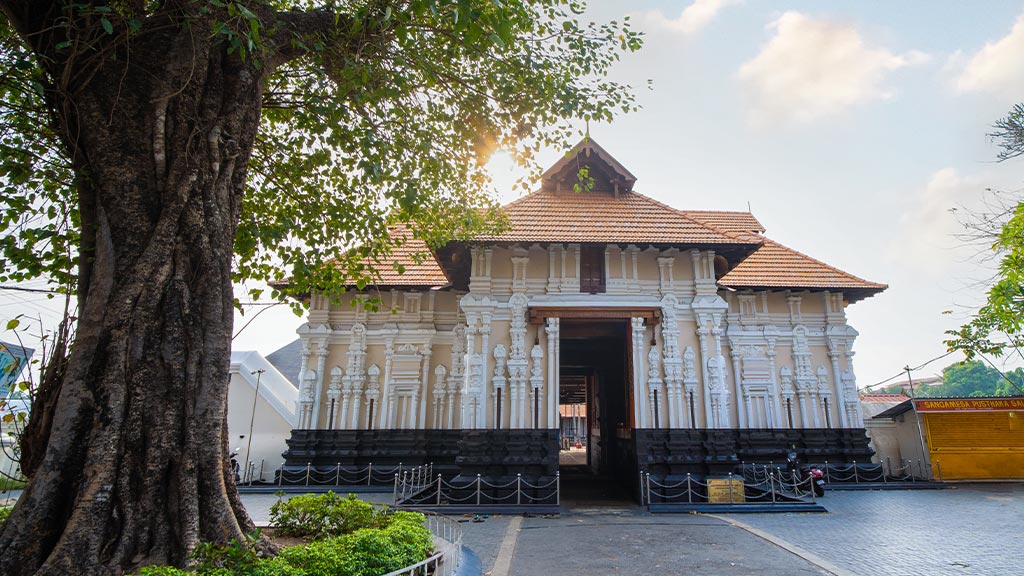
The Koodalmanikyam Temple in Irinjalakuda, Thrissur district, is the only ancient temple in India dedicated to Lord Bharata, the brother of Lord Rama. Dating back to the 9th century, with inscriptions from Chera king Stanu Ravi Varman dated 854 AD, the temple is an architectural marvel and a vital part of Kerala’s Nalambalam circuit. Despite its historic significance and substantial annual income exceeding ₹4.46 crores, the Court found the temple’s financial administration in a deeply unsatisfactory state.
252 Audit Objections, Missing Records, and Manual Accounting
The petition, filed by Jayasankar S and Jinoy K.J with the assistance of the legal team of Indic Collective Trust, revealed that approximately 252 audit objections pertaining to the period from 1990-1991 to 2016-2017 remain unresolved. The audit reports disclosed gross financial and administrative mismanagement, persistent irregularities, and serious governance lapses spanning decades.
In compliance with the Court’s directions, the Administrator of Koodalmanikyam Devaswom filed a statement revealing that the Devaswom’s total income for 2025 was ₹4,46,92,312, with annual expenditure of ₹4,10,06,194 and cash and bank balances of ₹1,47,17,293. Shockingly, despite this substantial turnover, the accounts are still maintained manually under the double-entry bookkeeping system, and computerisation has not become fully operational, reportedly due to financial constraints.
The minutes of a meeting held on March 17, 2026, convened by the Commissioner to address pending audit issues, revealed even more alarming facts. Records pertaining to the period from 1990-1991 to 2003-2004 are no longer available, reportedly due to termite infestation and damage caused by water leakage. For the audit period from 2004-2005 to 2009-2010, the Devaswom had not furnished any response whatsoever to the majority of audit objections. A similar pattern was discernible for 2015-2016 to 2016-2017. Despite the absence of any explanation or supporting materials, authorities proposed closing many of these audit paragraphs on the premise that no further action was required.
Court’s Strong Reprimand
The Court expressed serious concern over this approach, observing that such a course of action renders the entire audit exercise largely ineffective and undermines the very object of the statutory mechanism intended to ensure financial discipline, accountability, and transparency. “This Court cannot shut its eyes to such glaring deficiencies in the administration of an institution which manages substantial public funds and properties held in trust for the benefit of the deity and the devotees,” the Bench observed.
The Court noted that the annual ten-day Ulsavam festival costs approximately ₹1.68 crores, with the entire amount generated through public donations, sponsorships, and by leasing out Devaswom grounds for temporary exhibition stalls. “When such substantial amounts are received from the public and expended for the conduct of the festival and the day-to-day administration of the Devaswom, it becomes imperative that every receipt, expenditure, voucher, and supporting record is properly documented, digitally recorded, and capable of being independently verified,” the Court stated.
Statutory Framework and Obligations
The Court extensively referred to the Koodalmanickam Devaswom Act, 1971. Section 23 mandates that the Committee shall keep regular accounts of all receipts and disbursements, with accounts subject to concurrent audit. Section 25 requires auditors to specify all cases of irregular, illegal, or improper expenditure. Section 26 empowers the Commissioner to initiate surcharge proceedings against the Committee or officers guilty of misappropriation or gross neglect resulting in loss to the Devaswom, directing them to personally reimburse the amount.
The Court found that the maintenance of accounts and conduct of audit were not in conformity with this statutory mandate. “The absence of such vital financial records seriously undermines the accountability and transparency expected in the administration of a public religious institution,” the Bench observed.
A Pattern of Judicial Intervention
This judgment is part of a growing trend of judicial intervention in the administration of Devaswom boards in Kerala. In recent months, the same Bench has ordered the Travancore Devaswom Board to digitise accounts across its 1,250 temples following a ₹40 lakh embezzlement at a petrol pump run by the Board. The Court observed that “continued reliance on archaic manual record-keeping, the absence of digitised accounting systems, and the failure to conduct timely audits reflect gross administrative indifference”. The Court has also directed the digitisation of Sabarimala temple accounts and flagged financial deficiencies in the management of the Travancore Devaswom Board. Following this trend, the proceedings in this case have exposed deeper systemic issues plaguing government-controlled temple administration in Kerala. Over the past six weeks, as the High Court has continued its hearings, a troubling pattern of bureaucratic indifference, non-compliance, and administrative failure has emerged.
The Administrator Gets Schooled
On July 17, 2026, the Administrator appeared before the Court. What followed was nothing short of a dressing-down by the Bench. Justice Raja Vijayaraghavan V, visibly frustrated, repeatedly asked the Administrator what records he possessed. The Administrator could not produce a single record pertaining to audit objections pending since 1990. According to his affidavit, old records were “lost in floods,” and new ones “can’t be produced.”
“You keep saying you don’t have anything whenever I ask something,” the Judge remarked, as recorded by those present in the courtroom. When the Administrator claimed that records post-2019 would be digitized by a vendor called Cubic Software Solutions, the Court noted that even the papers for 2019 were unavailable. “You are a senior officer but this shows you are not good enough,” the Bench observed sharply.
The Court also questioned the efficacy of the proposed digitization software. When the Administrator admitted that Cubic could only show receipts and that Income-Expenditure reports could not be generated, Justice Vijayaraghavan appeared to have lost all patience. “What is the use of this software? How can this administration be called decent? This shows that you don’t respect this Court as you seem to have lied in affidavit saying you have proper accounts since 2019,” the Judge remarked. At one point, the Court asked pointedly: “You want us to write that you are totally inefficient in the order?”
The Bench expressed dissatisfaction with the Administrator’s performance and called for the Commissioner to appear, questioning how the temple could run efficiently under such management. An interim order was pronounced, stating that the Court had doubts about whether the “Kshetra Suvidam” software proposed for digitization would ensure proper management. The Commissioner was directed to file an affidavit.
The Commissioner’s Vague Affidavit
On July 29, 2026, the Commissioner filed an affidavit through his Joint Secretary instead of filing it in his name. The petitioners’ counsel, Sri. K.S. Bharathan, immediately objected to this, pointing out that no one seemed to be willing to take responsibility for the mess. Justice Vijayaraghavan, while noting the technical objection, observed that the affidavit itself was vague. The Court noted that the affidavit stated the Commissioner had directed the Administrator to come up with a proposal for digitization and receive tenders from PSUs including the Information Kerala Mission.
However, the Bench observed that the Administrator did not appear to have the expertise to prepare such a proposal. The Court pronounced an order directing the Commissioner to come up with a sensible plan, specifically, to have the Administrator assisted by a consultant from the National E-Governance System or the Centre for Management Development for preparing the proposal.
Tagging with Cochin Devaswom Board Case
On August 20, 2026, the case was tagged with another petition concerning audit irregularities in the Cochin Devaswom Board. The Court admitted that “all devaswom boards seem to have financial issues” while noting that these temple boards, with crores of revenue, are yet to adopt digital maintenance of accounts. It must be noted that the court had earlier remarked that digitization of accounts is something which a salon with a ₹20 lakh annual turnover is doing nowadays. The Court also warned of a decision on “whether the wheel needs to be reinvented,” a clear hint at scrapping the current government-controlled structure post-digitization of records.
The Case for Temple Liberation from State Control
The proceedings in the Koodalmanikyam Devaswom case have brought into sharp focus the broader question of state control over Hindu religious institutions. Indic Collective Trust, which has been providing legal assistance to the petitioners, has consistently advocated for the liberation of temples from government control and their restoration to devotees and traditional custodians.
The arguments advanced by the petitioners and their legal team reveal a fundamental flaw in the current model of temple administration: instead of focusing on the core statutory functions of maintaining proper financial records, ensuring accountability, and preserving temple properties, the state-appointed administrators and politicians have allowed decades of mismanagement to fester. The Koodalmanikyam Devaswom, with its substantial annual income of over ₹4.46 crores, stands as a glaring example of how bureaucratic control has led to financial indiscipline, loss of records, and complete disregard for statutory obligations.
On the other hand, the devotee-administration model has proven remarkably effective in temples like Payammal, Thoduppuzha, Chidambaram, Udupi, and Dharmasthala. In these temples, traditional custodians and devotee representatives manage affairs with far greater transparency, efficiency, and reverence for the institution’s sacred character. The contrast with the government-controlled model, as evidenced by the Koodalmanikyam case, could not be starker.
Further it must be noted that over the years instead of focusing on their core responsibilities like the maintenance of proper financial records and collection of land revenue, the politicians and officers of Koodalmanikyam Devaswom over the decades have been illegally interfering with religious practices while neglecting their statutory duties. The broader argument, as articulated by legal observers and advocates of temple liberation, is that a secular government should not be managing religious institutions. When the state administers temples, it inevitably leads to the kind of bureaucratic indifference and financial mismanagement that the High Court has now laid bare. The argument follows that true secularism demands that the state disengage from the administration of religious institutions and allow devotees and traditional custodians to manage their own sacred spaces.
What Lies Ahead
The matter remains pending before the Division Bench. The Court has made it abundantly clear that the current state of affairs is unacceptable. The Administrator has been found wanting, the Commissioner’s affidavit has been termed vague, and the proposed digitization software has been questioned for its competence.
The Court’s warning about “reinventing the wheel” suggests that more fundamental changes may be on the horizon, possibly including a complete restructuring of how temples in Kerala are administered. The Bench has also hinted at a larger decision on whether the existing government-controlled model should be scrapped altogether.
For now, the Koodalmanikyam Devaswom stands as a cautionary tale: an institution of immense historical and spiritual significance, generating crores in revenue, yet crippled by decades of bureaucratic neglect, missing records, and a stubborn refusal to embrace basic financial transparency. The High Court has made it clear that this cannot continue. Whether the administration will finally comply, or whether the Court will be forced to take more drastic action, remains to be seen.