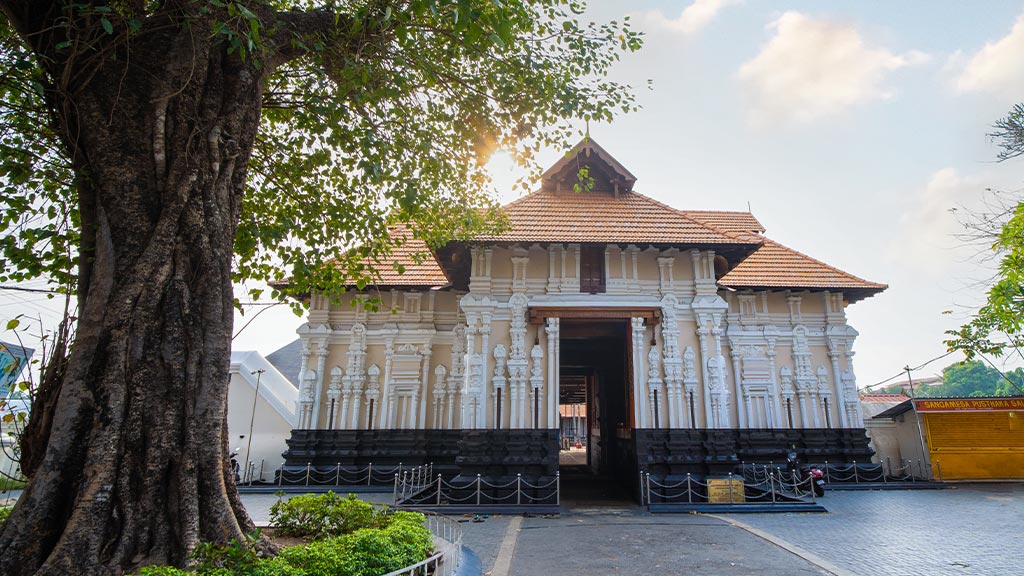
The Depleted State of Srivilliputtur Andal Temple: A Cry for Help
The Chariot, the Mandapam and the Missing Inscriptions and the lethargy of Temple Heritage Protection in Tamil Nadu
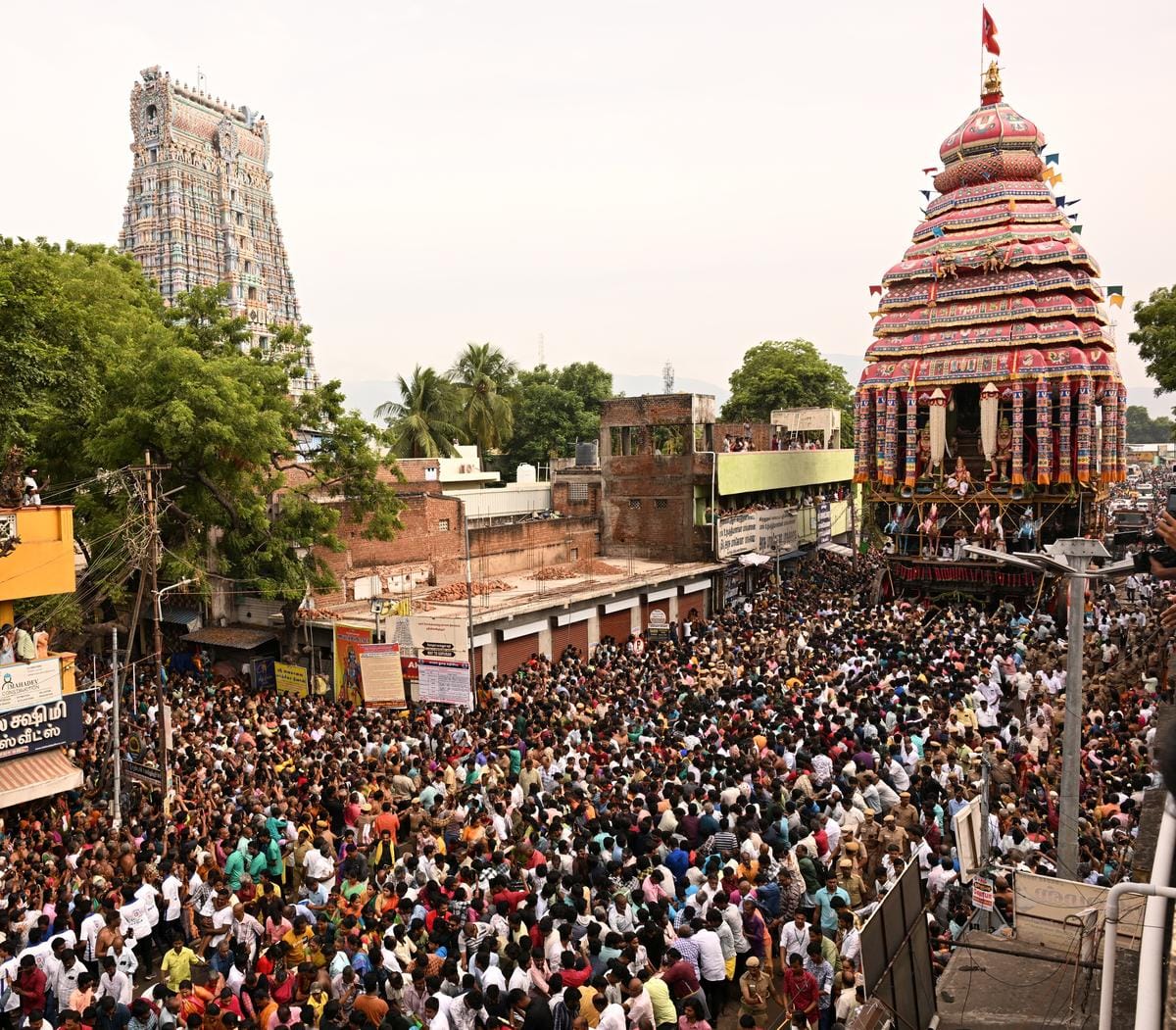
An 1868 photograph of the formidable temple chariot -second biggest in the state- of the Arulmigu Nachiyar (Andal) Temple at Srivilliputtur shows a procession of exceptionally carved wooden figures running along its tiers. A more recent photograph of the same chariot shows iron rods bolted around its frame, several of the original figures nowhere to be seen. Between these two images sits a question that custodians of Indian heritage and temples, the many bodies like the Archaeological Survey of India (ASI), the Hindu Religious & Charitable Endowments Department (HR&CE) in Tamil Nadu has continually neglected: who is responsible when a living, working temple, one that is used every single day, begins to lose its ancient treasures to neglect, haste and modern repair?
This question now sits before the Madurai Bench of the Madras High Court, in a case built around the Arulmigu Nachiyar (Andal) Temple at Srivilliputtur in Virudhunagar district, one of Tamil Nadu’s oldest (8th-to-9th-century) and most revered Vaishnavite shrines, the goparam of the temple serving as the official emblem of Tamil Nadu state itself. What the underlying papers describe is a legal campaign to preserve the slow depletion of this temple: over time, this beautiful temple inlaid with carved wood is facing deterioration and serious case of disregard – the wood has weakened by water, sculptural fragments unaccounted for, inscriptions that are slowly being lost, all of it happening to a monument that is ancient and yet nobody in office has been made to answer for.
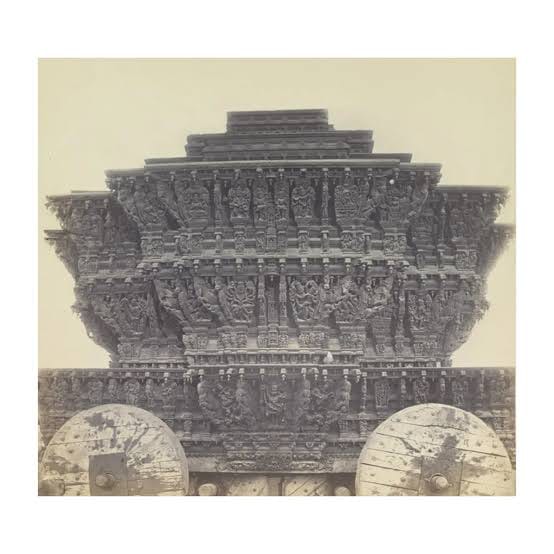
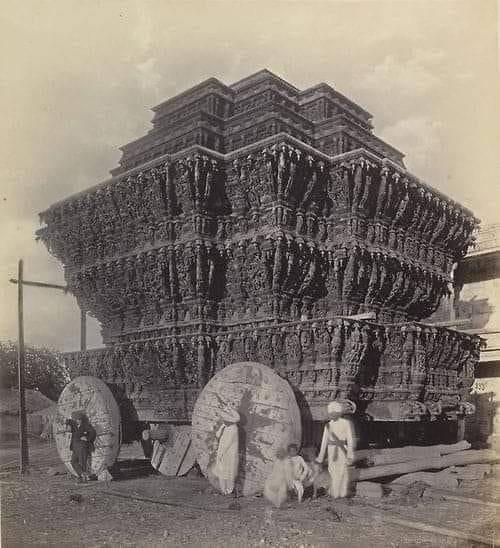
Archival photograph showing original sculptural richness of the chariot
What triggered the notice
Conservation of a living temple cannot mean freezing it in time as is done for monuments. Because unlike abandoned monuments, temples require maintenance. Electrical systems must be installed, water ingress must be arrested, wooden structures require repair and festival chariots must remain safe for use. Yet the fact that intervention is necessary does not mean that every intervention is permissible. In an ancient structure, the method of repair is often as important as the decision to repair.
This is the concern at the heart of proceedings initiated by the Managing Trustee of Indic Collective Trust in relation to the above-mentioned Andal Temple. We found three major issues with the temple in its present state:
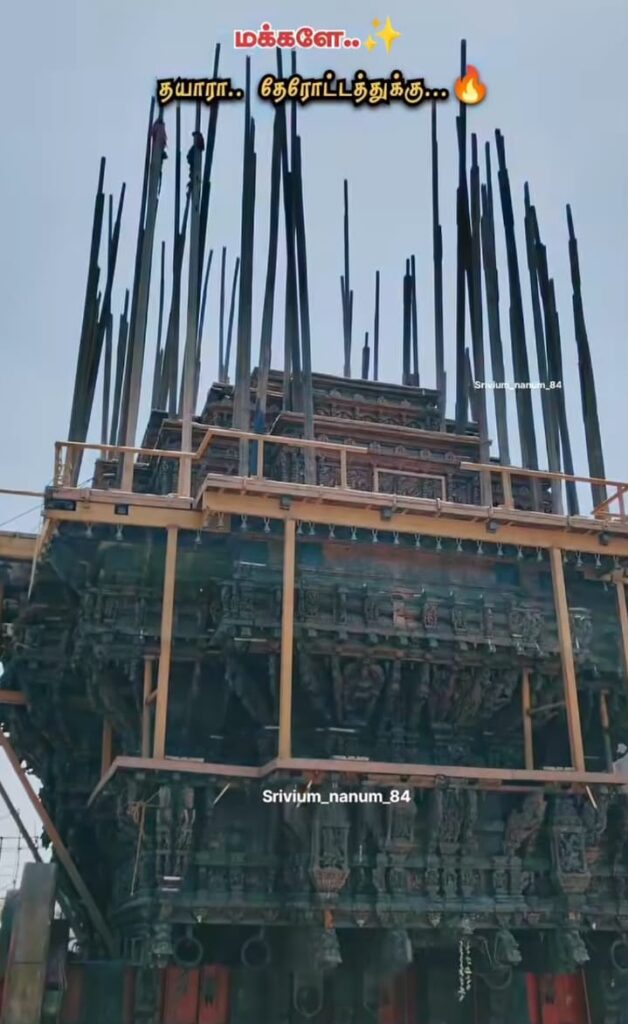
i. The first concerned the temple’s ancient wooden chariot. Photographs showed multiple iron rods and supports fixed around the chariot with no disclosed conservation design, structural report or approval from a competent heritage authority. Comparison with an archival photograph, stated in the pleadings to date to approximately 1868, suggested that several carved wooden figures visible in the older image were absent from the chariot in its present form.
[ Photograph showing further modern metal/wooden support arrangement around the chariot]
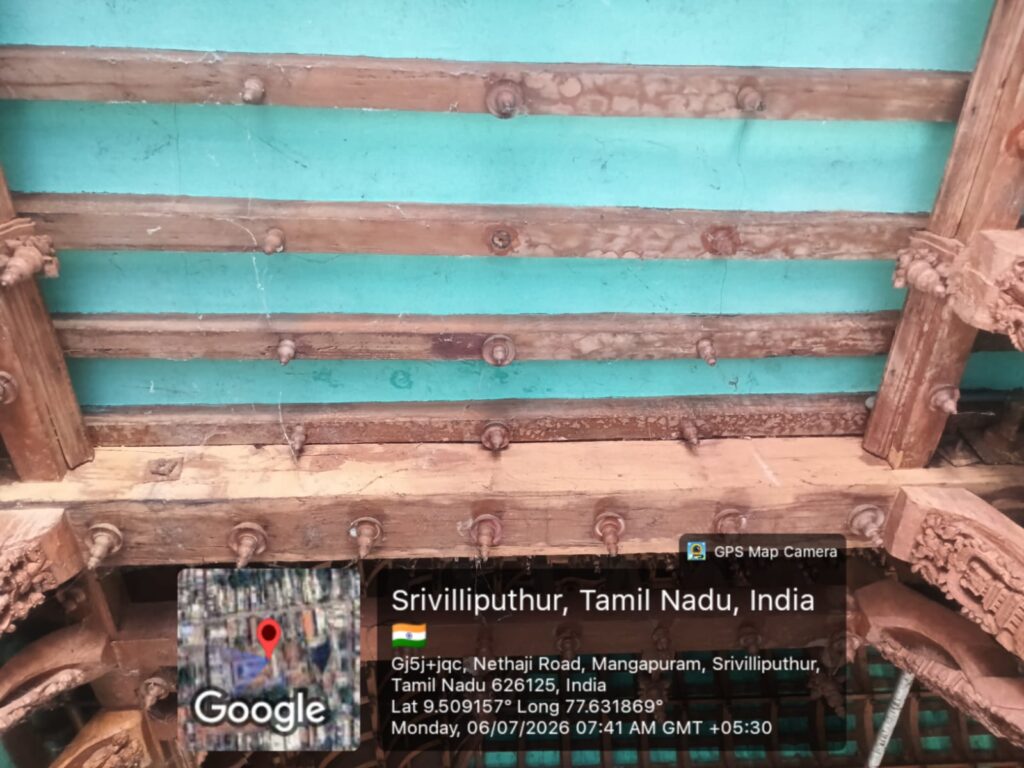
ii. The second concerned the Gopala Vilasam Mandapam, a structure associated with Uthram Thirunal Maharaja of Travancore, containing wooden members and carvings that require specialist conservation. Recent photographs showed water seepage, discoloration and possible fungal or biological decay, alongside modern electrical and fan-related fittings installed in the vicinity of ancient wooden columns and beams. If holes had indeed been drilled into original wooden members to run wiring or fix fans, as the photographs suggested, this would count as direct interference with the old structure of the temple.
[Close photograph showing damage in wooden beam/member]
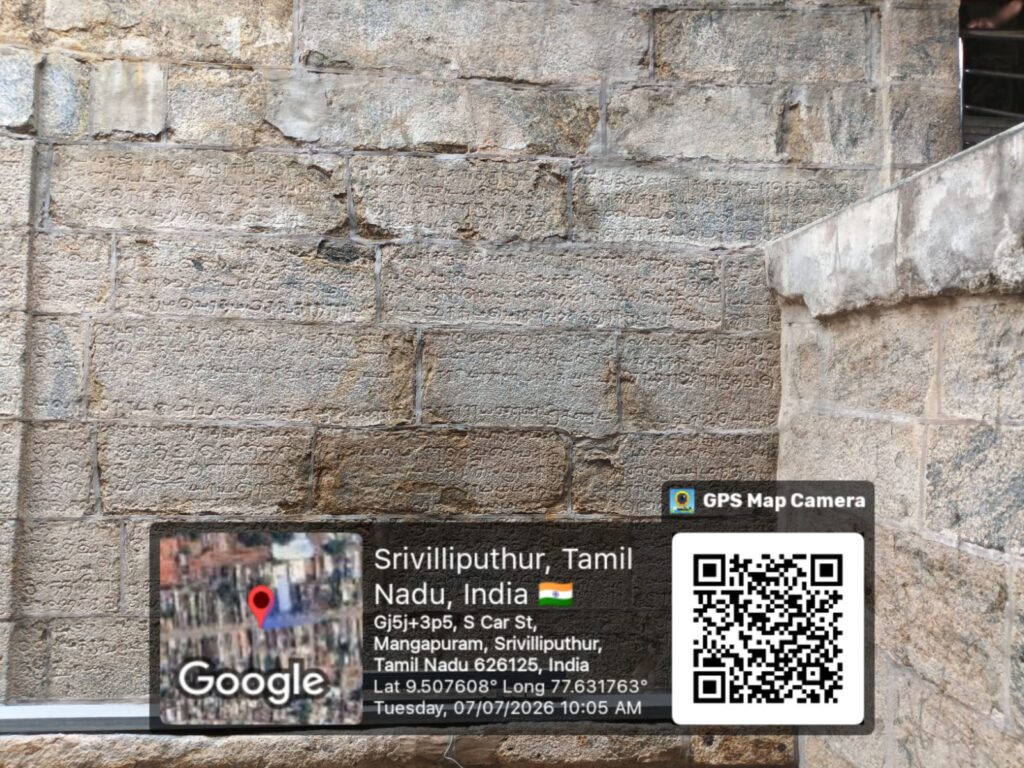
iii. The third concerned stone and wall inscriptions bearing epigraphical and historical value. Abrasive cleaning, possibly sand-blasting, had been used in the course of recent renovation, a method that permanently strips patina, tool marks and shallow incisions. For an inscription, even such marginal loss is primary historical evidence that cannot be recreated once lost.
[Photograph showing damaged/abraded stone/wall inscription allegedly affected by sand-blasting/abrasive cleaning]
To address these, in July, Mr. G. Aravindalochanan, Managing Trustee of Indic Collective Trust and a native of Srivilliputtur, instructed his counsel to issue a legal notice to the Director General of the Archaeological Survey of India, the Superintending Archaeologist of ASI’s Trichy Circle, the Tamil Nadu Secretary for Tourism, Culture and Religious Endowments, the HR&CE Commissioner, the jurisdictional Joint or Assistant Commissioner of HR&CE for the Virudhunagar and Madurai region, and the Executive Officer of the temple. The notice was grounded in photographic and archival material and raised these distinct sets of concerns.
The reply that answered less, revealed more
The Superintending Archaeologist of ASI’s Trichy Circle replied within days, an administrative promptness that deserves credit. The substance of the reply, however, is where the case becomes genuinely interesting.
The reply, dated 17 July 2026, stated three things. First, that the temple has not been declared a monument of national importance under the Ancient Monuments and Archaeological Sites and Remains Act, 1958, and is therefore not under ASI’s routine care and maintenance. Second, that repair and restoration of damaged structures or inscriptions falls within the jurisdiction of the Heritage Committee of the HR&CE Department. Third, that ASI Trichy Circle would extend technical expertise if requested by the concerned department.
Read quickly, this looks like a complete answer. Read carefully, it answers a contention the notice never made. At no point did our notice assert that the temple had been notified as a monument of national importance. That would have been a straightforward, easily disprovable claim, and competent counsel would not have staked the case on it. The notice instead rested on an entirely separate and, as it happens, far stronger source of obligation: a binding judgment of the Madras High Court itself explained in the next section.
But, herein it’s quite evident how bodies like ASI and HR&CE are playing the game of shifting responsibilities, an unending cycle of institutional merry-go-round in which responsibility is continuously transferred but never assumed.
Why a High Court judgment outranks a statutory technicality
In 2021, a Division Bench of the Madras High Court decided a suo motu writ petition, registered as W.P. No. 574 of 2015 and connected with W.P.(MD) No. 24178 of 2018, concerning the state of temples across Tamil Nadu. The judgment, delivered on 7 June 2021, issued seventy five directions covering nearly every aspect of temple heritage governance: the constitution of State and District level expert committees, periodic inspection regimes, documentation standards before any repair, and, critically, specific obligations placed directly on ASI.
Several of these directions bear no relationship whatsoever to whether a particular temple has been centrally notified. Direction 10 requires a conservation manual for both heritage and non-heritage temples, prepared jointly by Central and State archaeology officials along with HR&CE. Direction 11 requires ASI to conduct a state-wide field survey of temples more than a hundred years old, estimate the damage they have suffered, and place the resulting assessment in the public domain. Direction 13 requires HR&CE, assisted by ASI, to grade temples into listed and non-listed categories on the basis of architectural value, historic importance and age, a classification whose very existence presupposes that non-listed temples remain within the scheme. Direction 14 requires the protection of stone and wall inscriptions, wooden carvings and temple antiquities generally. Direction 17 requires ASI to inspect temples over a hundred years old, and Direction 18 goes further, requiring annual archaeological inspection and supervisory visits across the board. Direction 23 specifically instructs that sand-blasting be avoided in cleaning temple buildings, a direction that speaks almost prophetically to the very grievance raised in this case. Direction 64 extends central implementation obligations to religious structures more than a hundred years old, expressly including temple chariots, art and artefacts.
None of this turns on whether the temple carries a Central notification. The 1958 Act governs one narrow category of ASI’s work, its ordinary statutory custodianship of declared monuments. The 2021 judgment governs something broader: a state-wide set of directions issued by the Madras High Court in the exercise of its writ jurisdiction, binding on ASI because ASI was itself a party to that very litigation. A public authority cannot answer a demand founded on the second by pointing only to the first. That, in essence, is the argument advanced in the rejoinder issued on 18 July 2026, and it is a sound one. A writ court’s power under Article 226 to enforce compliance with its own prior directions does not evaporate because a narrower central statute happens not to apply to the particular monument in question. If anything, the doctrine of harmonious construction requires reading the 1958 Act’s silence and the 2021 judgment’s specificity together, not treating the former as though it repeals the latter by implication.
The wider statutory architecture
The legal notice and the writ petition that followed it do not rest on the 2021 judgment alone. They draw on a layered structure of law that, on paper, is unusually protective of Indian temple heritage.
Article 49 of the Constitution places an affirmative obligation on the State to protect monuments and objects of artistic or historic interest from spoliation, disfigurement, destruction or removal. Article 51A(f) makes it a fundamental duty of every citizen, and by extension of public bodies acting in the citizen’s name, to value and preserve the composite cultural heritage of the country. Neither provision is ordinarily enforceable on its own, being outside Part III, but Indian courts have long read such provisions into Article 21 and into the public trust doctrine that governs how the State holds resources of common heritage. Temple antiquities, chariots and inscriptions sit comfortably within that doctrine. They are not assets at the unfettered disposal of whichever administrator happens to hold office. They are held in trust for devotees, for scholars, and for generations not yet born.
The Tamil Nadu Hindu Religious and Charitable Endowments Act, 1959 supplies the operative duty at the ground level. It requires the trustee or Executive Officer to administer temple property with the care that a prudent person would exercise over personal property, and it mandates the maintenance of registers recording movable property, idols, ancient records and historical items. An absent inventory, or an inventory that cannot account for figures visible in an 1868 photograph, is not a minor administrative gap under this Act. It is the precise failure the Act was designed to prevent.
The Tamil Nadu Heritage Commission Act, 2012 adds a further, and frequently overlooked, layer. Section 11 of that Act, drafted with a non obstante clause that overrides inconsistent provisions elsewhere, requires reference to the Heritage Commission on any matter touching the identification, restoration or preservation of a heritage building, and on any engineering or development work likely to affect one. Section 15 makes the Commission’s advice mandatory to implement, not merely persuasive. If sand-blasting or drilling occurred without reference to this Commission, that alone would constitute a statutory breach independent of anything decided in 2021.
Where a structure or object happens to be separately notified under the Ancient Monuments and Archaeological Sites and Remains Act, 1958, or its state counterpart, the Tamil Nadu Ancient and Historical Monuments and Archaeological Sites and Remains Act, 1966, those stricter regimes would apply in addition. But as the rejoinder correctly notes, the absence of such notification narrows only one channel of protection. It does not empty the temple of every other legal safeguard available to it.
The Fine Print vs Between the Lines
What makes the Srivilliputtur file valuable beyond its own facts is how neatly it illustrates a recurring failure mode in Indian heritage governance. A temple that is centrally protected gets ASI’s direct attention, imperfect as that attention sometimes is. A temple that is not centrally protected falls into an administrative gap where the State department in charge, here HR&CE, often lacks in-house conservation expertise, and the Central agency with that expertise, ASI, treats the absence of notification as grounds to step back rather than step in. Each authority can, on a narrow reading of its own enabling statute, say that the primary duty lies elsewhere. The 2021 Madras High Court judgment was written precisely to close that gap, by imposing survey, inspection and advisory duties on ASI that do not depend on notification status at all. The ASI reply in this case, whatever its intentions, reproduces exactly the gap the judgment was meant to close, by answering the notification question and staying silent on the seventy five directions.
To ASI’s credit, its reply did offer technical expertise if HR&CE were to ask for it. The rejoinder seizes on this sensibly, pointing out that there is now no institutional obstacle left to a joint inspection: HR&CE has been named by ASI’s own letter as the department with jurisdiction, and ASI has put its willingness to assist in writing. What remains is coordination, not authority. Two departments waiting for each other to move first, while water continues to work through wooden beams and while the discrepancy between the 1868 photograph and the present chariot goes unexamined. Such impasse are however pretty common not just legally but administratively. While many laws protect the Srivilliputtur temple, ASI and HR&CE hide behind technical legalities while the temple lays waste.
What comes next
With no substantive response from HR&CE, the temple administration, or the other authorities notified, and with ASI’s reply held to be legally insufficient on its own terms, Indic Collective has filed a writ petition under Article 226 at the Madurai Bench, seeking a coordinated mandamus. The relief to be sought includes an independent expert inspection, preservation of records and physical evidence pending that inspection, a technical and financial audit of works already carried out, and compliance with the specific directions of the 2021 judgment that the ASI reply chose not to address.
Whatever the eventual outcome, the case deserves attention. Tamil Nadu has, on paper, one of the more elaborate heritage protection frameworks in the country: a dedicated Heritage Commission Act, a landmark suo motu judgment with seventy five enforceable directions, and a religious endowments statute with real teeth. What this case tests is whether that framework can actually compel two arms of the State to act in concert before damage becomes permanent, or whether it will continue to function only as paper protection, invoked after the fact in litigation rather than applied in practice on the ground. Until then, the temple’s own condition, water finding its way into three-hundred-year-old timber, a chariot bearing the marks of hurried and undocumented repair, inscriptions that are slowly being erased remains the most honest evidence in the case. For a country with tens of thousands of centuries-old temples still in daily ritual use, most of them outside the narrow list of centrally notified monuments, the answer to what the law will actually do about that evidence matters well beyond Srivilliputtur.
This article is based on the legal notice dated July 2026, the reply of the Archaeological Survey of India dated 17 July 2026, the rejoinder dated 18 July 2026, and the writ petition prepared in the matter of G. Aravindalochanan, Managing Trustee, Indic Collective Trust.