The Unsung Shield of Kanchi: Reclaiming the Forgotten History of Maratha Sacrifices at the Sri Devarajaswamy Temple
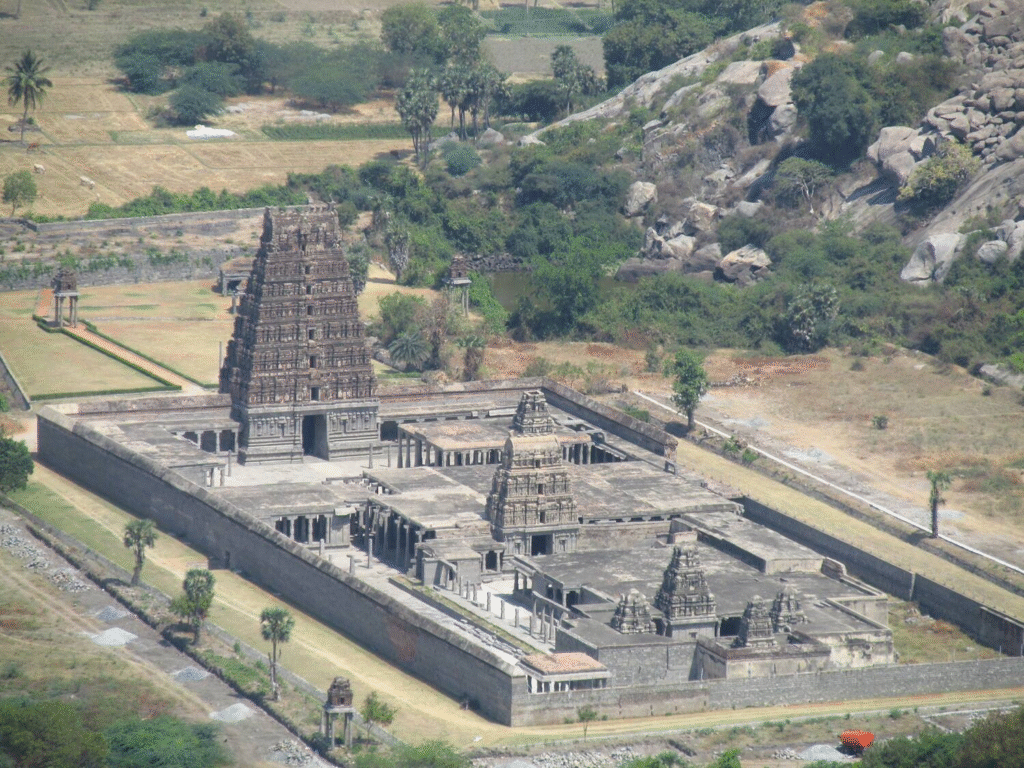
Walk through the majestic corridors of the Sri Devarajaswamy (Varadaraja Perumal) Temple in Kanchipuram, and you will find yourself surrounded by stone inscriptions, grand architecture, and sacred history. Yet, in the Mandapa leading to the steps of Sri Perundevi Thayar Sannidhi, sits a striking anomaly: a statue honoring Lala Todarmal. Todarmal was an administrative and military general functioning directly within the imperial apparatus of the Arcot Nawab and the Mughal Empire. Local temple records and modern folklore celebrate him as the grand deliverer who rescued the temple’s sacred processional deity, the Utsava Murti, from exile and reinstated it in 1710.
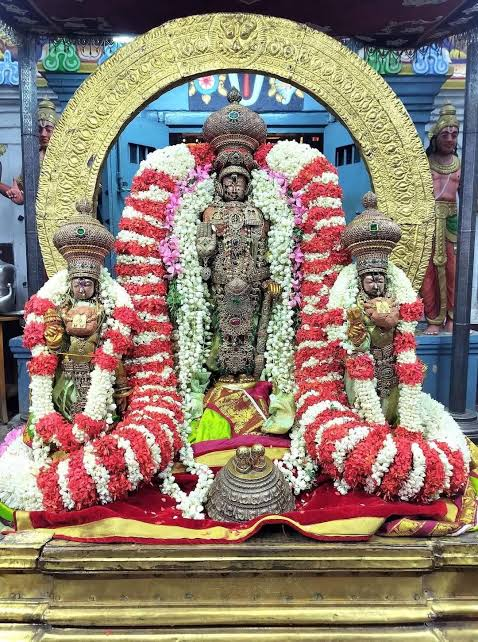
That memory is not false. But it is incomplete. The Utsava Murti of Lord Varadaraja left Kanchi twice, not once. The first removal occurred around 1645–46, following the collapse of Vijayanagara Empire, when the Tatachars carried the deity to Mysore to escape the invading forces of the Bijapur Sultanate. For decades, the primary utsava murtis (processional deity) remained outside Kanchi, even as local archakas (priests) and devotees continued nitya pujas (daily worship) to preserve the temple’s ritual life.
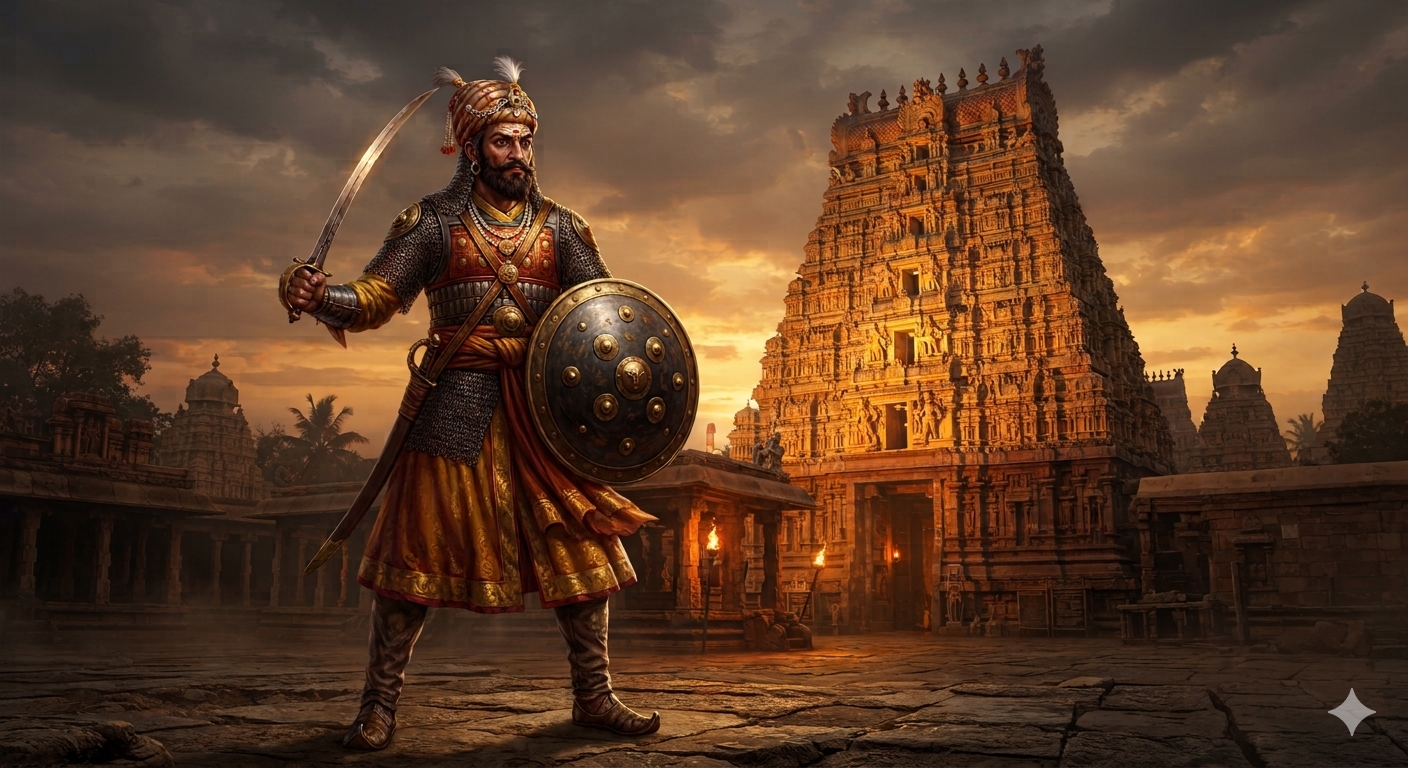
The Marathas fundamentally changed the balance of power in the Carnatic. Chhatrapati Shivaji Maharaj’s capture of Gingee in 1677 gave the region a vital measure of security. Under Chhatrapati Sambhaji Maharaj, Haraji Raje Mahadik (Shivaji’s son-in-law and the Maratha Subhedar of the Carnatic) restored worship, confirmed temple inams (land endowments), protected pilgrims travelling to Kanchi, and helped restart the annual Brahmotsavam.
The second removal came in 1688, during the Jyeshtabhishekam festival, as Aurangzeb’s generals advanced on Kanchipuram. The deity was sent to Udayarpalayam, where it remained until 1710. Its eventual return was not the work of a single man. Thanjavur Maratha minister Jagannath Pandit applied the pressure that broke the Udayarpalayam deadlock; Lala Todarmal, an official within the Arcot Nawab’s administration, provided the formal military escort that brought the Murti safely home.
Todarmal’s contribution deserves remembrance, but it was the Marathas who provided the shield. They defended Kanchi, restored its temples, and made the final return possible, without demanding permanent statues, titles, or sectarian primacy in return. This essay recovers that forgotten debt, not to diminish anyone’s faith or service, but to honor the fuller story of who saved Kanchi.
The Shield Against the Bijapur Sultanate
Following the complete annihilation of the Vijayanagara Empire, the physical structure of the temple witnessed a continuous storm of invasions by the Bijapur Sultanate beginning in 1645-46. In response to these invasions, the Tatachars moved to Mysore with the Utsava Murti of Lord Varadaraja for safekeeping. Not much has been spoken about this first exile and it hardly remains in oral traditions today. However, the fact that the murti remained unharmed despite the massive loot of the temple in 1650s during which the gold plates of Punyakoti Vimana and other mandapas were removed and taken away from the temple shows that it was impossible for the murti to have stayed in Kanchi during this period.
This era of unchecked loot and destruction in Kanchi ended with the arrival of Maratha Mawalas under Chhatrapati Shivaji Maharaj in 1676 which boosted the morale and strength of local Hindus. Shivaji Maharaj’s capture of Gingee in 1677 finally gave a sense of security and stability to the local population. He also put an end to the slave trade that was carried out by Dutch in Northern Tamil Nadu with the help of Bijapur forces.
Immediately after the capture of Gingee, Shivaji Maharaj appointed his Minister Raghunath Pant as the incharge of Gingee and ordered him to restore and restart worship in 4 Punya kshetras namely – Tiruvannamalai, Srimushnam, Vridhachalam and Chidambaram. In his Rajya Vyavahara Kosha, which is predominantly a Durbar record of Shivaji Maharaj, Pant mentions the restoration of these temples. However, continuous incursion from both Mughal and Sultanate sides made it difficult for both Pant and Shivaji Maharaj to allocate funds for renovation of other sacred sites such as Kanchipuram.
Haraji Raje Mahadik: The Unyielding Wall (1681–1689)
One such name which cannot be ignored while mentioning the resistance against this imperial storm was Haraji Raje Mahadik. Appointed by Chhatrapati Sambhaji Maharaj as the Maratha Viceroy (Subhedar) of the Carnatic in 1681 post the demise of Raghunath Pant, Haraji Raje ruled from the fortress of Gingee. He was married to Ambika Bai, Shivaji’s daughter, making him both Sambhaji’s brother-in-law and his trusted viceroy. His tenure was a masterclass in defensive warfare. In the early 1680s, fading factions of the Adil Shahi dynasty of Bijapur attempted to strip the Carnatic plains of their wealth to fund their collapsing capital. Marathi Subhedar Haraji Raje rapidly deployed Maratha garrison forces across the Palar river basin, checking the advances of these roving armies and ensuring that the local temple administrations around Kanchi retained their territorial security.
The Administrator Behind the Sword: Restoring the Temples
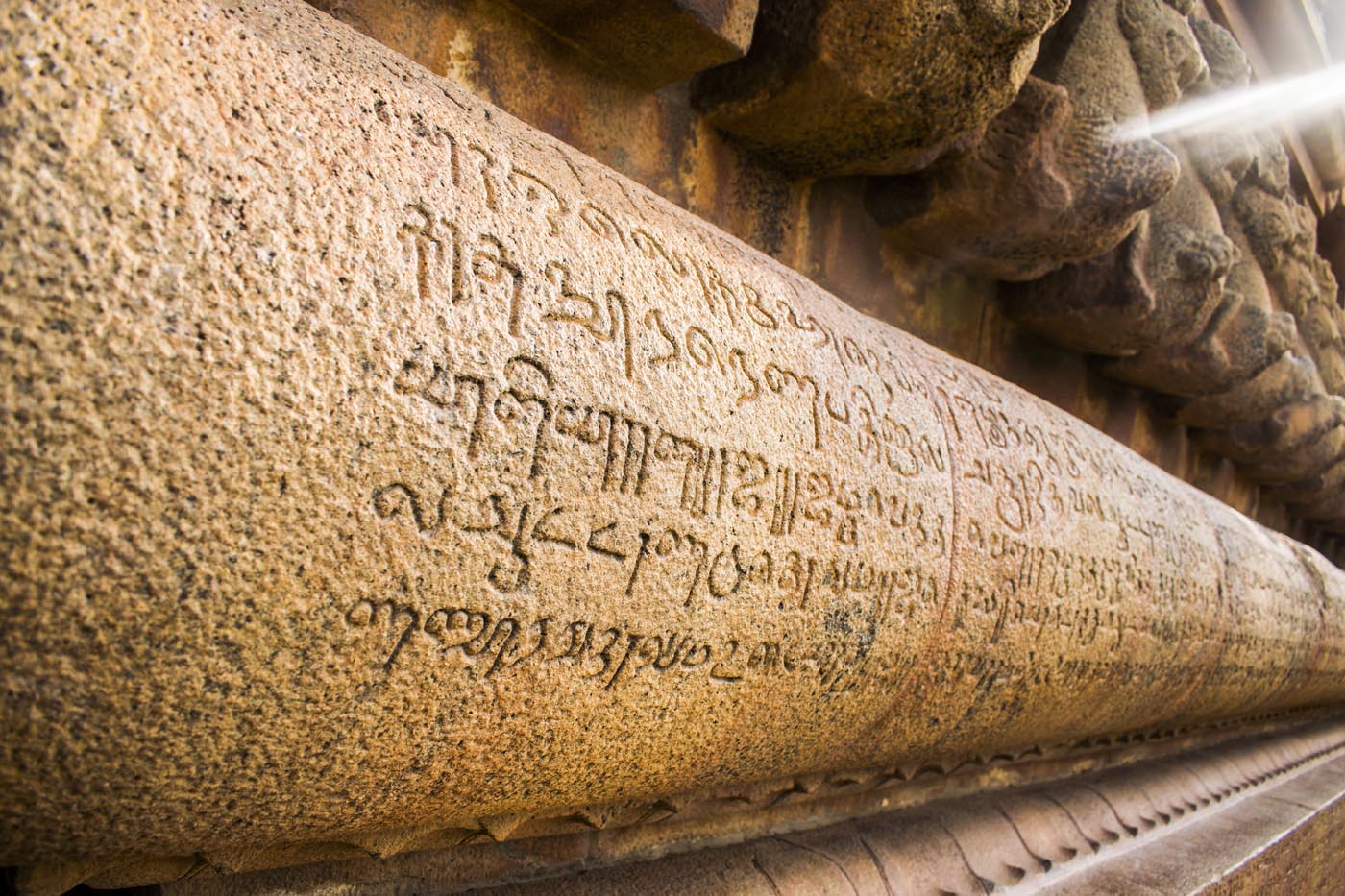
Haraji Raje’s defense of Kanchi was not limited to the battlefield. Archival records from the Gingee subah reveal that he was equally committed to the spiritual and economic restoration of the region’s sacred institutions. Hence, immediately after taking charge in Gingee, Haraji embarked on the mission of restoring and restarting worship in the dilapidated temples of Kanchi. As a result, the utsava murtis which were housed in Mysore were brought back with respect along with the Tatachars. Thus, proper daily worship was restarted in the abode of Lord Varadaraja. It must be noted that the temple has a few inscriptions during this period of invasion from 1645 to 1677 and one of them details tirtha maryadas to a local devotee. This shows that local Hindus were brave enough to conduct nitya pujas in the temple even in the absence of primary utsava murtis and annual utsavas.
Detailing the efforts of Haraji in restoring the dilapidated temples of Kanchi and arranging for their nitya pujas, C.K. Srinivasan in his Maratha Rule in the Carnatic mentions:
“Haraji Raje quickly moved to restore order in the distracted province, confirming the traditional inams (land endowments) and charities originally granted by previous rulers to the great temples of Kanchi and Chidambaram. By securing temple lands from arbitrary revenue extraction by local poligars of Bijapur, he ensured that daily worship, which had been suspended during the transition of power, was systematically revived.”
This shows that Haraji’s act was not a transactional favor but a deliberate policy of religious restoration.
The Jedhe Shakavali (Jedhe Chronology), the most precise contemporary Marathi record, details the movement of Haraji Mahadik’s troops safeguarding local pathways. In the year Shubhakrit (1682–83), Haraji Mahadik moved with the Maratha Huzarat forces toward the Carnatic plains to establish absolute control. Word was sent across the subah that pilgrims traveling to the sacred Kshetram of Kanchi for the annual Brahmotsavam would receive state protection. Cavalry units under Jaitji Katkar were positioned along the northern highways to repel any local pillagers. Thus we can see that the famous Annual Brahmotsavam of Lord Varadaraja which ceased in 1645-46 due to the fear of invasions was restarted in 1682, thanks to the efforts of Haraji Raje Mahadik.
The Mackenzie Manuscripts contain localized temple logs (Kaifiyats) that further document the ground reality of Maratha rule. The Kanchipuram Kaifiyat records how Haraji Mahadik’s administration interacted directly with the spiritual leaders of the region:
“When the Maratha Subhedar Haraji Raje assumed the seat at Jinjee (Gingee) on behalf of the Sovereign Shambhu Raje, he paid his respects to the main shrines of the town. He issued explicit mandates to the local revenue officers stating that the lands belonging to the Varadaraja and Ekambaranathar shrines should not be touched for state taxes, and that the traditional honours due to the Archakas and hereditary keepers must remain fully protected as per past custom.”
The Reign of Sambhaji: A Period of Sacred Restoration
The commitment to Kanchi’s temples was not unique to Haraji Raje; it was a defining feature of Chhatrapati Sambhaji Maharaj’s reign. During this period, significant consecration and restoration activities took place across most sacred sites of Tamil Nadu including those in Kanchipuram, cementing the Maratha legacy as protectors of Dharma.
The pratishta of the Kalvar (Adi Varaha Perumal) shrine within the Kamakshi Amman temple complex was formally established. The Nila Thingal Thundam shrine was installed within the Ekambareshwara temple. Thus two Divya Desams praised by the Alvars, were restored and reconsecrated, ensuring the continuity of worship. While traditionalists argue against arbitrary practice of combining temples of different sampradayas, the lack of financial strength and need to continue worship at a time when many doubted the survival of Hindu traditions and rituals justifies this move of Marathas which saved capital and ensured continuity of worship. Furthermore, three Divya Desa Murtis of Kanchipuram from dilapidated temples were housed and formally reconsecrated within the Ulagalantha Perumal temple complex (Thiru Kaaragam, Thiru Karvaanam, and Thiru Neeragam), restoring the ritual integrity of these sacred precincts.
These acts of consecration were not merely administrative; they were spiritual declarations. By restoring these murtis, the Marathas under Sambhaji’s sovereignty were declaring that the sacred geography of Kanchi would not be allowed to fall into neglect or desecration, regardless of the political storms raging around them.
The Storm from Golkonda: The 1688 Invasion and The Second Exile
The true test came with the fall of Golkonda in September 1687, which radically altered the balance of power in the Deccan. Aurangzeb, singularly focused on dismantling the great religious institutions of the South, turned his gaze toward the Carnatic.
In a calculated move to eliminate the Maratha presence, Aurangzeb dispatched four generals from the conquered kingdom of Golkonda: Ismail Khan Maka, Yachappa Nayak, Rustam Khan, and Mahammad Sadiq. On February 25, 1688, this formidable imperial force, comprising 4,000 cavalry and 7,000 infantry, arrived at Kanchipuram. The sacred city was in the crosshairs of imperial expansion.
The Tatachars, who had returned with the Utsava Murti in 1681 under Haraji Raje’s protection, now faced a second existential threat. When the invading forces attacked the city during the Jyeshtabhishekam festival, the Tatachars smuggled the deity out of the city and escorted it to Udayarpalayam, where local Zamindars provided sanctuary. For twenty-two years, the sanctum remained dark; the Brahmotsavams and Garuda Sevas were suspended.
When the massive Mughal force arrived at Kanchi, Haraji Raje refused to cede the sacred territory. The historical record shows that the Marathas strategically retreated to their nearest forts on either side of the river Palar, avoiding a pitched battle that would have meant certain annihilation. Instead, they engaged in a relentless, high-friction guerrilla campaign. For over a year, the two armies clashed in frequent skirmishes, with the Marathas successfully preventing the systematic demolition of Kanchi’s primary temple complexes and checking the imperial advance.
The Reconquest of Kanchipuram: Defiance and Famine
The defense of Kanchi was not merely defensive; it was a series of bold offensives. The imperial forces had garrisoned Poonamalle and Vandavasi, freely plundering the surrounding territories. Haraji Raje ordered his commander, Keshav Pingle, to proceed north of the river Palar to expel the Mughals.
When Pingle refused this order at the fear of having to take on a massive force of Mughals in plains without any geographical advantage, Haraji Raje did not hesitate. He sent a detachment under two of his own officers, which successfully peeled the land of its Mughal supremacy, reconquered Arcot, Kanchipuram, and Poonamalle, and re-established Maratha dominance over the sacred landscape. While Keshav Pingle eventually repented and independently plundered Mughal Garrisons of Chetpat and Kaveripauk, his insubordination revealed the intense internal strains of the campaign.
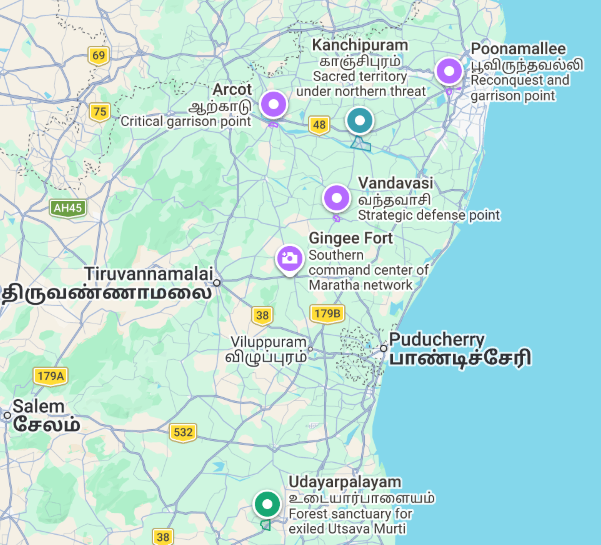
The sheer physical toll of sustaining this multi-front war was immense. A terrible famine ravaged the entire region. The organized brigandage continued for a year, devastating the local economy. Yet, Haraji Raje held the line and successfully repelled the invasion in early 1689.
The Turning Point: The Fall of Sambhaji and the Siege of Gingee
The year 1689 brought catastrophe for the Maratha Empire. In February 1689, Chhatrapati Sambhaji Maharaj was captured by the Mughals. What followed was one of the most gruesome chapters in Indian history. Aurangzeb subjected Sambhaji to forty days of savage torture, demanding he surrender and convert to Islam. Despite being paraded through the streets, blinded, tongue torn apart and having his body parts mutilated one by one, Sambhaji refused to bow. On March 11, 1689, he was finally beheaded on the eve of Gudi Padwa (Marathi New Year), his body cut into pieces and thrown to dogs on the banks of the Bhima river.
The news of this brutal execution sent shockwaves through the Maratha Empire. The distant provinces began to drop away from loyalty. When Haraji Raje heard the news, his spirit of defiance was severely tested. The Mughals, emboldened by their success and the plight of Maharashtra, pushed further south to Tiruvannamalai. Haraji Raje suspected the loyalty of his own nobles and troops. In a bold move to secure his position, he captured Keshav Pingle at Tiruvannamalai, freeing himself from the danger of a non-yielding commander.
Despite the overwhelming might of Aurangzeb, the collapse of the central Maratha administration at Raigad, and the devastating famine, Haraji Raje contemplated but ultimately rejected the idea of accepting Mughal overlordship. Instead, he strengthened the fortress of Gingee and increased his army, preparing to challenge the Mughals from that impregnable place.
The Final Stand: Zulfikar Khan and the Siege of Gingee
Following the execution of Chhatrapati Sambhaji Maharaj in early 1689, Aurangzeb dispatched his premier general, Zulfikar Khan, to stamp out the southern Maratha node at Gingee. Haraji Raje held the Carnatic lines against the opening movements of this campaign. The sheer physical toll of sustaining a continuous multi-front war took his life; Haraji Raje passed away in late September 1689. He died having given his entire life to ensure that the temples of Kanchi outlasted the first wave of Mughal destruction.
While some local traditions and later Maratha ballads suggest Haraji Raje may have fallen in a direct skirmish with Zulfikar Khan’s advancing forces, the contemporary historical records, including the Jedhe Chronology, firmly place his death on September 29, 1689, before the formal commencement of the siege. What remains undisputed is that his passing left a void in the Carnatic command that was filled by his widow, Ambika Bai – the daughter of Chhatrapati Shivaji Maharaj, who governed the province.
The 1710 Breakdown: Transaction vs. Triumph
By 1710, the regional political landscape had shifted, and the Kanchi custodians sought to bring the Utsava Murti home. However, they hit a geopolitical deadlock: the local Chieftain of Udayarpalayam, having grown accustomed to the spiritual prestige of hosting the deity, refused to surrender the icon.
The traditional narrative isolates the resolution of this crisis to Lala Todarmal. In reality, Todarmal was merely the delivery mechanism. The true leverage that broke the deadlock was applied by Jagannath Pandit, a brilliant administrative commander and top minister of the Thanjavur Maratha kingdom.
Working alongside his spiritual preceptors Sri Bheemaraja Goswami – the Rajaguru of Thanjavur Marathas and the 22nd Pontiff of Uttaradhi Mutt Sri Satyapurna Tirtha, whose predecessor Sri Satyabhinava Tirtha was escorted to safety by Tatachars during the 1688 invasion, Jagannath Pandit mobilized the deep territorial and military weight of the southern Maratha network. He applied sustained pressure on Udayarpalayam which left the Chieftain with no choice but to capitulate. Only after Jagannath Pandit broke the local resistance did Lala Todarmal, acting as an official bureaucrat within the Nawab’s state apparatus, step in to provide the formal military escort that marched the deity safely back to Kanchi ensuring that the procession of the murti will be unharmed by Mughal forces. These efforts can be found from the documents of Uttaradi Mutt and the Modi documents confirmed by descendants of Sri Bheemaraja Goswami.
Todarmal executed a political transaction that suited the Arcot Nawab’s desire for local administrative stability. The Marathas, conversely, executed a civilizational rescue mission.
The Politics of Memory: Re-examining the Todarmal Narrative
The modern institutional memory that elevates a single Nawab-aligned general over decades of Maratha military sacrifice invites a necessary historical re-examination. This is not an attack on any community or tradition, but a call for scholarly honesty about the complex forces that shaped the temple’s survival.
Todarmal was, by all accounts, a man who sought recognition for his services. His statue is clearly seen on the mandapa leading to the steps of Goddess Perundevi Shrine. He built statues of himself and his family not only in Kanchipuram but in Tirumala and Srirangam as well. At Tirumala, his statues were placed prominently, a placement that some contemporary observers found unusual for a lay general. He was an ardent devotee of Atthaan Jeeyar, a Thenkalai preceptor, and his intervention in the temple’s affairs was not purely devotional. It also served to advance the ritual rights of his sect.
When the Tatacharyas approached the Thenkalai Jeeyar for the help of Todarmal in retrieving the Utsava Murti from Udayarpalayam, the Jeeyar “took this opportunity to lay conditions that Thenkalai devotees must be given the right to chant Prabandhams (Tamil devotional hymns) inside the temple in return for helping get the utsavar murthi back to the temple.” The Tatacharyas agreed, but with a rider that their family would start and end the Prabhandham chanting. This agreement, the Atthaan Jeeyar Agreement, became the legal foundation for Thenkalai ritual rights in the temple.
None of this diminishes the sincere faith of Thenkalai devotees today, nor the legitimacy of their traditions. However, it does complicate the simple narrative of Todarmal as a selfless deliverer. He was a complex figure who used his position to advance both the temple’s interests and his own sectarian interests along with self-promotion.
The Marathas, by contrast, sought nothing for themselves. Haraji Raje Mahadik confirmed temple inams, protected pilgrims on the highways to Kanchi, and issued explicit mandates that the lands of the Varadaraja and Ekambaranathar shrines “should not be touched for state taxes.” Jagannath Pandit funded the Dwajasthambam and dispatched guilds of Sthapathis to repair the sanctum walls. They did not condition their protection on ritual or sectarian concessions, nor did they demand permanent memorials in the temple’s inner spaces. They worked to protect local traditions and rituals without expecting anything in return.
This is not to say that Todarmal’s contribution should be erased. He did provide the military escort that brought the deity home. But the historical record deserves to be complete. The Maratha contribution to the temple’s survival, military, administrative, and material, deserves much more recognition alongside the transactional role that Todarmal played.
Timeline of the Kanchi Civilizational Rescue
Below is a chronological overview of the geopolitical crisis and the sustained Maratha campaign to protect the sacred landscape of Kanchipuram.
Written in Gold and Stone: The Material Traces of Maratha Devotion
The local temple circles may have forgotten the names of Haraji Raje and Jagannath Pandit, but the temple itself has not. The physical structure of Sri Varadaraja Perumal Temple bears the indelible material signature of the Maratha restoration:
- The Dwajasthambam and Deepasthambam: The monumental flagstaff that stands today as the ritual axis of all Kanchi festivals was constructed and gilded by the patronage of Jagannath Pandit. It was built to replace the structures destroyed during the decades of conflict and served as a bold structural message to the landscape: The Lord has returned, and the flag of Dharma flies again. Further, the tall Deepasthambam made of a single granite stone also stands as a message that the Light of Dharma emerges tall after every period of darkness.
- The Thanjavur Murals and Sudhai Motifs: During the 22-year abandonment, the walls of the sanctum had degraded significantly. Jagannath Pandit did not merely send funds; he dispatched specialized guilds of Maratha-patronized Sthapathis. They repaired the collapsing plaster and overlaid the inner gopuram layers with the distinct, rich, heavy-profiled Thanjavur-style murals and sudhai (stucco) motifs that pilgrims still walk past today.
Conclusion: Towards a More Complete Memory
The historical record invites us to broaden our understanding of who saved the temple of Kanchi. Lala Todarmal received an eternal place in the Thayar Sannidhi because he was the immediate face of the bureaucratic handback. But the Marathas, who expended blood and treasure as a matter of pure duty, never demanded contracts, titles, or statues.
Recognizing the era of Chhatrapati Sambhaji Maharaj, the relentless defense of Haraji Raje Mahadik, and the structural legacy of Jagannath Pandit does not diminish the contributions of others, it honors the very foundation upon which the temple stands. The Marathas and the temple’s traditional custodians were not adversaries; they were partners in the preservation of Dharma against overwhelming odds.
Hence, it is time for us to begin to acknowledge a 340-year-old debt of gratitude to the unsung shields of Vishnu Kanchi. By expanding the temple’s historical memory to include all those who sacrificed for its survival, the temple can honor the fullness of its own past – not as a contest between communities, but as a shared heritage of devotion and resilience. So, the next time you visit Kanchi, pause at the Dwajasthambam. Look up at the flag mast of Dharma. And remember the men who died so that it could hoist the Garuda Dhwaja.
References
This historical reconstruction synthesizes distinct primary epigraphic, administrative, and literary records to balance local folklore with contemporary documentation:
1. The Jedhe Shakavali (Jedhe Chronology): A highly precise, contemporary Marathi record that accurately dates the tactical troop movements of Haraji Raje Mahadik’s Huzarat forces and Jaitji Katkar’s cavalry units along the Palar river basin.
2. The Mackenzie Manuscripts: Localized temple logs and revenue records that document Haraji Raje’s direct interactions with Kanchi’s traditional Archakas, verifying the explicit mandates protecting temple lands from state taxes.
3. Maratha Rule in the Carnatic by C.K. Srinivasan: A foundational historical study detailing the administrative confirming of traditional inams (land endowments) to the great shrines of Kanchi and Chidambaram during the late 17th century.