Opening the Pandora’s Box: How a Leftist Appetite for Sacrilege Unleashed the Greatest Religious Movement of the Century
by a Correspondent Convinced That Civilisations Perish Not by the Sword but by the Footnote
Part One: The Desecration and Its Architects
I. Sabarimala – The Epitome of a Denominational Institution
There are religious institutions, and then there is Sabarimala.
To speak of the them in the same breath is to mistake the candle for the sun, the creek for the ocean. For, Sabarimala is not merely a temple in the geographical sense – a pile of stones and consecrated mortar administered by a statutory board and periodically inconvenienced by a government that cannot decide whether it worships Marx or Makaravilakku. Sabarimala is a theology compressed into a mountain, a denomination crystallised around the most austere and demanding of devotional architectures, a sacred compact between a god who chose celibacy and the pilgrims who mirror that celibacy back to him across forty-one days of fasting, black-clad austerity, and the sublime surrender of the self that the Hindus have always called vrata.
Understand the deity first before you presume to lecture his devotees. Lord Ayyappa of Sabarimala is not merely worshipped as celibate – he is the celestial Naisthika Brahmachari, the eternal renunciant who has taken the vow not for a season but for all time, not as a discipline but as his very svarupa, his essential form. The four Shastha shrines of Kerala map this cosmic biography with architectural precision: the deity appears as the divine child (Bāla) at Kulathupuzha, as the perpetual celibate (Brahmachari) at Sabarimala, as the forest ascetic (Tāpasa) at Aryankavu, and as the wedded householder (Bhāryā-sameta) at Achankovil. To worship at Sabarimala without observing the vratham is not merely irreverent – it is a logical contradiction, as absurd as lighting a lamp to celebrate darkness, as coherent as attending a Cistercian monastery’s vigil service in order to make noise.
The Pandalam royal family, whose ancestors installed this deity under the covenant of 995 ME, have maintained since the agreement assigning administrative control to Travancore in 1820 a single, non-negotiable condition: the customs and rituals will be followed in the traditional way. The Thazhamon Madom family has held the Tantric office – the hereditary right to prescribe and police the ritual order – in unbroken succession. The Thiruvabharanam procession, that annual return of the divine ornaments from the Pandalam Palace to the summit shrine for the Makaravilakku, is not pageantry but is a constitutional text, the living preamble of a denomination that knew what it believed, why it believed it, and how it was to be conducted, centuries before the Indian Supreme Court knew that it existed.
Justice Indu Malhotra, the sole dissenter in Indian Young Lawyers Association v. State of Kerala ((2019) 11 SCC 1), the infamous 4:1 verdict of 28 September 2018, was the only member of that bench who actually read the record. At paragraph 12.3, relying on the Travancore Devaswom Board’s own notification of 27 November 1956, she recorded the obvious: that the worshippers of Lord Ayyappa at Sabarimala “together constitute a religious denomination or sect thereof,” following a “distinct faith” and “well identified practices.” At paragraph 12.9(ii), she identified the 41-day Vratham and the deity’s Naisthika Brahmachari form as customs identifiable as practised on the foundation of that common faith. At paragraph 13.7, drawing on the Tanthri’s own testimony, she held that the “limited restriction” was “central and integral to the tenets of this shrine, since the deity has manifested himself in the form of a Naisthik Brahmachari.”
These were not the conclusions of sentiment. They were the conclusions of evidence – evidence that the majority, in its haste to constitute a constitutional reformation it had not been asked to undertake, chose to dismiss with the breezy observation that there was “no identified group called Ayyappans.” One marvels at this reasoning. There is no group called “Trinitarian Catholics” in the Oxford Dictionary of Proper Nouns either and yet nobody has suggested that the Pope lacks denominational autonomy.
The Ayyappa sampradaya has a distinct theology: the Naisthika Brahmacharya of the presiding deity. It has a distinct practice: the 41-day Vratham, the irumudikkettu, the Sharanam call. It has a distinct pilgrimage architecture that no other temple in India replicates. It has a hereditary Tantric authority. It has a royal custodian. It has, and this the majority somehow missed, millions of devotees who live the denomination’s demands with a devotion that makes the petitioners’ paper-filed grievances look, by comparison, like the protest of tourists who object to the dress code of a cathedral they wandered into without invitation.
II. Et Tu, Brute? The Sword Swung from Within
History reserves its richest ironies for those who mistake tactical cleverness for strategic wisdom, and the Bharatiya Janata Party’s conduct in the first week of October 2018 is a case study that will instruct political scientists for decades.
On 28 September 2018, the Supreme Court delivered its verdict. And the BJP, that self-anointed custodian of Hindu civilisation, that party which had spent thirty years harvesting the electoral yield of temple politics, from Ayodhya to Udupi to Guruvayur, looked at the Sabarimala verdict and saw not a desecration but an opportunity. The Union Law Minister welcomed the judgment as a triumph of “gender equality.” Party workers were instructed to wait, to see, to read the room. Strategists in Lutyens Delhi, whose knowledge of Sabarimala pilgrimage extended no further than a Wikipedia search, calculated that Hindu women would vote in gratitude for a party that had delivered them access to a deity they had, by and large, never sought access to.
This was not merely wrong. It was the kind of wrong that compounds itself, the kind that reveals not merely an error of calculation but an error of civilisational understanding.
The women of Kerala who descended on Sabarimala in the weeks following the verdict were not the liberated petitioners of the legal imagination. They were women who had observed the 41-day Vratham, who wore the mala, who called themselves Ayyappa devotees and who refused to enter. The “Ready to Wait” campaign, organised not by the Sangh Parivar but by devotee women themselves, made visible what the court had rendered invisible: that the majority of women connected to this shrine considered the restriction not an oppression but a covenant, not a disability but a devotional identity.
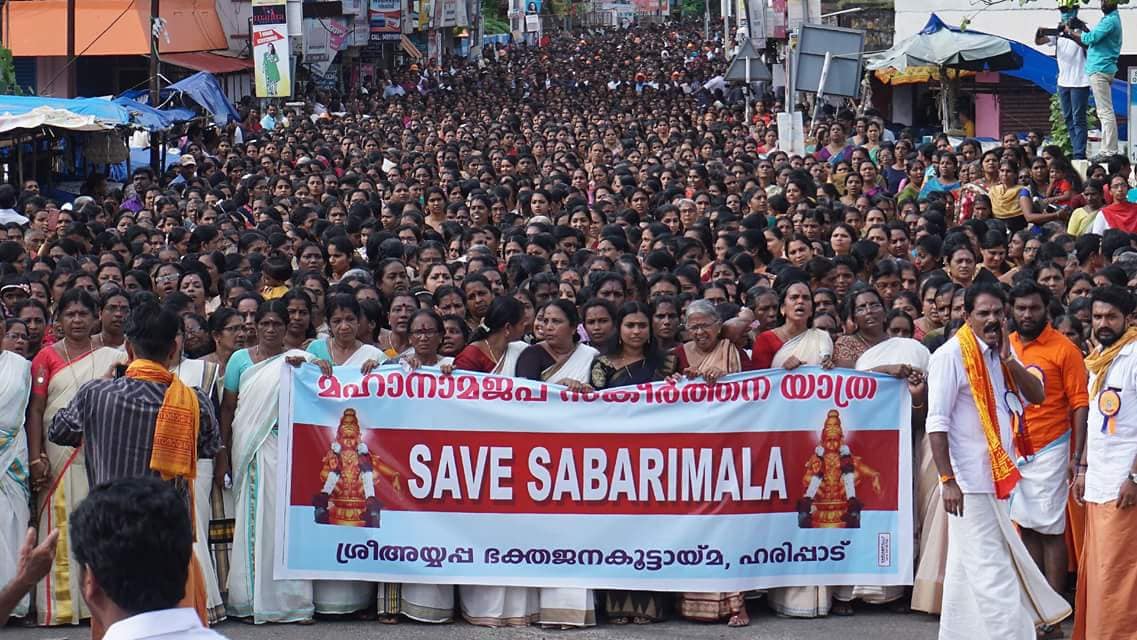
The Nair Service Society mobilised. The Vishwa Hindu Parishad organised the Ayyappa Jyothi lamp chain across 640 kilometres on 26 December 2018. The Sangh ran agitations that resulted in over 3,000 arrests. And on 1 January 2019, the Pinarayi Vijayan government staged its Vanitha Mathil, a 620-kilometre wall of women, funded by Rs. 50 crore siphoned from a social justice department, built to celebrate a verdict that a vast majority of Hindu women in Kerala had already repudiated at the temple gates. Before dawn on 2 January, Bindu Ammini and Kanaka Durga were escorted in by police, triggering protests that set the state ablaze.
The 2019 Lok Sabha elections rendered the verdict. The UDF won 19 of 20 Kerala seats. The BJP, despite seven months of agitation, despite K. Surendran’s arrest at Nilakkal, despite Mohan Bhagwat’s Vijayadashami speech, despite the RSS Karyakari Mandal resolution from Ranchi, won zero seats. Zero. Not a consolation. Not a near-miss. Zero. K. Surendran polled 29% in Pathanamthitta, the constituency that contains Sabarimala itself. The agitation had produced heat but no light, noise but no seats, a flame that warmed the rival’s hearth and scorched the arsonist’s hand.
The ironies do not stop there. The BJP, having initially declined to oppose the verdict, then filed review petitions when public outrage made silence untenable, only to discover that the Supreme Court, which had admitted the review, had then referred the whole matter to a nine-judge bench, thereby suspending any immediate reversal and converting a tactical retreat into a procedural labyrinth. The party that sought to ride the Sabarimala tiger had, in the end, been neither on the tiger’s back nor safely off it, but somewhere in between, stripped of both the devotional credentials it claimed and the progressive credentials it briefly coveted.
This is what happens when civilisational questions are submitted to the calculus of a psephologist.
III. The Reference Questions – Pandora’s Box, Opened
The Sabarimala review – Kantaru Rajeevaru v. Indian Young Lawyers Association (RP(C) No. 3358/2018), produced, on 14 November 2019, by a 3:2 majority, the most consequential judicial order of the decade: the reference of seven reformulated questions to a nine-judge constitutional bench. What was intended as a surgical correction became, once Justices Nariman and Chandrachud, in a prescient joint dissent, refused to participate, a wholesale reopening of the constitutional architecture of religious freedom.
The seven questions asked are nothing less than the foundational grammar of liberty in a plural state. What is the scope of Article 25? How does Article 26 interact with individual rights? Is “morality” in the Constitution popular morality or “constitutional morality”? Can courts engage in judicial review of religious practice, and if so to what depth? What are “Sections of Hindus”? And, most devastatingly for the petitioner class, can a person with no stake in a religion bring a PIL to demolish its practices?
That seventh question alone, had it been asked in 2006 when the writ was first filed, would have disposed of the entire controversy. The five petitioners in the original case – Bhakti Pasrija, Prerna Kumari, Sudha Pal, Alka Sharma, Laxmi Shastri – were not Ayyappa devotees. They did not observe the Vratham. They had no personal grievance. They brought their petition in the posture of liberators, arriving uninvited at a threshold they had never wished to cross, armed with constitutional provisions they had never needed, to deliver a freedom that nobody inside had asked them for. Justice Malhotra at paragraph 7.3 captured the danger with the precision of a surgeon: “permitting PILs in religious matters would open the floodgates to interlopers to question religious beliefs and practices.” She was right then. She remains right now. And the nine-judge bench, if it has any regard for the integrity of its own proceedings, will make her right in law.
The reference also tagged petitions on Muslim women’s entry into mosques, Parsi women married to non-Parsis seeking access to the Agiary, and the Dawoodi Bohra FGM case. This is Pandora’s Box in its fullest fury, and its hinge is a single question: whether courts are theologians, or whether they are courts.
Part Two: The Doctrine, the Deception, and the Deliverance
IV. The Denomination, the Sampradaya, and the Oxford Dictionary’s Colonial Ghost
The great injury done to Hindu constitutional rights since 1954 has been perpetrated not with guns but with dictionaries, specifically, with the Oxford English Dictionary definition of “denomination,” a word coined in the language and context of Abrahamic Christianity, pressed into service to determine whether a Tantric sampradaya in the Sahyadri foothills qualifies as a constitutional denomination or merely as an administrative nuisance.
In Commissioner, Hindu Religious Endowments, Madras v. Sri Lakshmindra Thirtha Swamiar of Sri Shirur Mutt (AIR 1954 SC 282), the foundational charter of Indian religious freedom, Justice Mukherjea, writing with characteristic elegance and uncharacteristic cultural parochialism, adopted the Oxford definition: “a collection of individuals classed together under the same name: a religious sect or body having a common faith and organization and designated by a distinctive name.” This definition was adequate for identifying Methodists and Anglicans, Sunnis and Shias, in the denominational landscape of a colonial legal system built on the assumptions of Reformation Christianity. It is wholly inadequate for identifying the Veerashaivas, the Pancharatra Vaishnavas, the Smartha Shaktas, or the Ayyappa devotees, in a civilisation whose religious formations do not achieve identity through institutional church-building but through guru-shishya parampara, through iṣṭa-devatā devotion, through the transmission lineage that Sanskrit calls sampradaya.
Now mark this carefully, for it is the argument that should shake every constitutional bench that considers Article 26: the Hindi authoritative text of Article 26, which is constitutionally operative under Article 394A, does not say “denomination.” It says dharmik sampradaya. Sampradaya. A word that Monier-Williams, in his Sanskrit-English Dictionary (Oxford, 1899), defines as “any peculiar or sectarian system of religious teaching… tradition, established doctrine transmitted from one teacher to another.” A word that encodes within itself the very thing the Ayyappa tradition embodies: a received transmission, a living chain from the Tantric ancestors of the Thazhamon Madom to the pilgrims who blacken their clothes today.
The irony is exquisite, and it is also infuriating: the Oxford Dictionary was brought in to interpret a constitutional provision whose own authoritative text had already provided the Indian answer. Courts have been glossing an English translation when the original was already in the room, waiting to be read.
Justice O. Chinnappa Reddy, that most uncompromising of Indian constitutionalists, warned in his dissent in S.P. Mittal v. Union of India (AIR 1983 SC 1), against the “etymological deception” lurking in the denomination test. He cautioned that religion is not to be confined to the traditional, established, well-known or popular religions. He saw the trap. Subsequent benches walked right into it anyway.
The consequence has been systematic. Hindu communities – Shaivite, Vaishnava, Shakta, Tantric, folk-devotional – have been repeatedly denied denomination status on the grounds that they lack a common organisation in the Christian-ecclesiastical sense. They lack it because they never needed one. Sampradayas do not have synods. They have lineages. They do not issue membership cards. They transmit initiation. The three-part Shirur Mutt test – common faith, common organisation, distinctive name – was designed for the Free Church of Scotland. When applied to the Ayyappa tradition, it performs the quiet injustice of demanding that a banyan tree identify itself as a pine.
The sadachar argument completes this architecture. The content of a religious practice, what is essential to it, what is peripheral, what is mandatory and what is optional – is determined not by a bench that has read a newspaper article about the practice, but by the tradition itself, through what P.V. Kane’s History of Dharmashastra (Vol. III) calls sadācāra: the normative custom of the virtuous practitioners within the tradition. The Tantris of the Thazhamon Madom are not priests exercising a personal preference when they invoke the Naisthika Brahmacharya of Ayyappa. They are executing the sadachar of a Tantric tradition whose prescriptions they have custodied across centuries. The question of whether that practice is “essential” is not a question for lawyers – it is a question that the tradition has already answered.
V. The Socialist Nincompoops and the Doctrine That Ate India’s Traditions
But of all the doctrinal perversions visited upon Indian religious freedom in seventy-five years of constitutional history, none is more audacious, none more harmful, and none more intellectually dishonest than the Essential Religious Practices doctrine – that judicial monstrosity by which the Supreme Court of India arrogated to itself the power to decide not merely whether a practice would be protected, but whether it sufficiently mattered to the religion to deserve protection at all.
Let the contrast be stated plainly, because it is the hinge on which the entire constitutional argument turns.
In 1986, the Supreme Court of India decided in Bijoe Emmanuel v. State of Kerala ((1986) 3 SCC 615), a case involving three children of the Jehovah’s Witnesses faith who had been expelled from school for declining to sing the national anthem. Justice Chinnappa Reddy – the same judge who had warned against denominational etymology – wrote a judgment surpassing clarity and constitutional grace. He did not ask whether the refusal to sing was doctrinally central to Jehovah’s Witness theology. He did not commission a survey of Witness scriptures to determine whether silence during the anthem was a “core” or “peripheral” belief. He asked one question only: do these children sincerely and genuinely hold, as a matter of their conscience and religious conviction, that they ought not sing? And having found that they did – having found that their conduct is not the outcome of any perversity – he protected them. Full stop.
The United States Supreme Court had understood this decades earlier. In West Virginia State Board of Education v. Barnette (319 U.S. 624 (1943)) – Justice Robert Jackson, writing with an eloquence that the Indian bench of 2018 might have profitably imitated, held: “If there is any fixed star in our constitutional constellation, it is that no official, high or petty, can prescribe what shall be orthodox in politics, nationalism, religion, or other matters of opinion.” In the United States v. Ballard – (322 U.S. 78 (1944)) – Justice Douglas held that courts may inquire into the sincerity of a religious belief but never into its truth. And in Cantwell v. Connecticut (310 U.S. 296 (1940)) – the First Amendment’s religion clauses were made applicable to the states precisely on the understanding that the government has no role in determining religious truth.
These cases were decided in a country built by people who understood – from bitter colonial and sectarian experience – that the moment you allow the state to decide which religious beliefs are sufficiently important to deserve protection, you have handed the state the keys to the temple, the mosque, the synagogue, and the sampradaya. You have not merely regulated religion. You have constituted the government as its supreme theologian.
What happened in Commissioner v. Shirur Mutt (AIR 1954 SC 282) – was the Indian original sin in this domain. Justice Mukherjea wrote, at the relevant paragraph, what began as a protective principle: “what constitutes the essential part of a religion is primarily to be ascertained with reference to the doctrines of that religion itself.” So far, so good. The tradition defines itself. But having stated this, the Court immediately inserted the fatal qualification: the judiciary would verify, from without, whether the tradition had correctly identified its own essentials. The serpent had entered the garden.
From Shirur Mutt (1954), the slide was swift and irreversible. In Mohd. Hanif Quareshi v. State of Bihar (AIR 1958 SC 731) – the Court consulted Hamilton’s English translation of the Hedaya to determine that cow slaughter was not essential to Bakr-Id. In the Durgah Committee, Ajmer v. Syed Hussain Ali (AIR 1961 SC 1402) – Justice Gajendragadkar introduced the category of “superstition,” empowering courts to strip protection from practices deemed insufficiently rational. By the time the Court decided the Sabarimala case in 2018, it was operating with the confidence of a body that had been practising theology for sixty-four years and had forgotten, in the flush of that practice, that it had no qualification for it.
Rajeev Dhavan and Fali S. Nariman – two lawyers whose combined experience of the Supreme Court extends to more decades than some of the 2018 judges had been alive – wrote in their celebrated 2000 essay that the Court’s ERP inquiry had endowed judges with a power greater than any high priest, maulvi or dharmashastri. Pratap Bhanu Mehta, writing in Seminar (521, January 2003), observed that the Court had acquired “the authority to regulate and fix meanings of terms much as Hobbes enjoined his sovereign to do.” Faizan Mustafa and Jagteshwar Singh Sohi, in the BYU Law Review (2017), noted the conversion of the Supreme Court into “clergy.” And Upendra Baxi observed what nobody else in the Indian academy had the courage to say plainly: that the ERP doctrine produced not the protection of Hindu religion but its rationalisation into a form more convenient for the State – a “rationalized high Hinduism” that delegitimated folk practices, popular devotion, and Tantric traditions as “superstition” while elevating the Vedantic abstractions that colonial administrators had always found more governable.
The Ayyappa devotees were the latest and perhaps most dramatic victims of this process. The majority in 2018 found that the restriction on women between the ages of ten and fifty was not “essential” to the Ayyappa tradition – on the basis of reasoning that amounted, at its core, to the proposition that since all Hindus could in principle worship Ayyappa, the particular denomination’s practice could be overridden. Had the Bijoe Emmanuel test been applied, the inquiry would have been different, the answer inevitable, and the constitutional damage undone before it was done: do the Tantris, the Devaswom Board (in its uncorrupted form), and the millions of Ayyappa devotees sincerely hold that the Naisthika Brahmacharya of the deity requires the restriction? Of course they do. They have held it, practised it, and transmitted it for centuries.
The ERP test did not protect the Ayyappa tradition. It exterminated it – in nine paragraphs of judicial theology.
VI. Constitutional Morality – The Last Refuge of the Rationalist Tyrant
But the majority did not stop at excising the practice as “non-essential.” Justice D.Y. Chandrachud, in a concurring opinion of considerable intellectual ambition and, it must be said, considerable intellectual danger, introduced into the Sabarimala verdict the full-throated deployment of “constitutional morality” as a device for overriding both the denomination’s autonomy and the popular sentiment of its adherents.
Constitutional morality – a phrase borrowed from Ambedkar’s 25 November 1949 address but deployed by Chandrachud J in a sense its originator would have found alarming – was the instrument by which the majority declared that even if popular Hindu sentiment overwhelmingly supported the Sabarimala tradition, the tradition must yield to a higher constitutional imperative. The Constitution, on this reading, was not merely the law of the land – it was a competing theology, one in which the judge, and not the devotee, was the final interpreter of the sacred.
This is not constitutionalism. This is liberal totalitarianism in academic dress.
Ambedkar’s invocation of constitutional morality in 1949 was addressed to the legislature, not the judiciary – a warning that democratic majorities must not use their numerical power to strip minorities of their constitutional rights. It was a horizontal principle, addressed to the political branches. To transform it into a vertical judicial sword, capable of being wielded by any sitting bench against any popular religious practice that offends the sensibilities of a constitutional lawyer, is to take the most democratic of Ambedkar’s insights and to corrupt it into the most antidemocratic of outcomes.
And yet this is precisely what the Sabarimala majority and its academic cheerleaders attempted. They found “constitutional morality” where the Constitution’s own text found “denomination.” They found “untouchability” under Article 17 where Ambedkar himself had drafted only caste-based civil disability. They found a “right of entry” to the shrine under Article 25(2)(b) where Parliament had never extended that provision beyond places of public resort that are not denominational institutions. They found, in short, whatever they were looking for, because a court armed with “constitutional morality” and the ERP test is a court that can find anything.
The Attorney General K.K. Venugopal, in December 2018, was not being theatrical when he called constitutional morality “a dangerous weapon.” He was being precise.
VII. Ambedkar Saves the Day – The Great Doctor Speaks from the Record
And so we arrive at the great rescue : the constitutional evidence that the same liberals who invoke Ambedkar at every seminar and in every petition have systematically suppressed, misread, or ignored.
On 2 December 1948, in the Constituent Assembly – Volume VII, at a session the reader may verify on the ambedkar.org archive – Dr. B.R. Ambedkar spoke on what would become Articles 25 and 26 of the Constitution. He acknowledged that “the religious conceptions in this country are so vast that they cover every aspect of life, from birth to death.” He sought to limit the definition of religion to “beliefs and such rituals as may be connected with ceremonials which are essentially religious.” He was aware, that is, of the civilisational complexity of the tradition. He was not – whatever the 2018 majority implied – declaring open season on that complexity.
More precisely: in Annihilation of Caste (1936), in Who Were the Shudras? (1946), in Riddles in Hinduism (posthumous), Ambedkar consistently treats Shaivites and Vaishnavas as distinct sampradayas – distinct communities of practice with their own internal logics, their own transmission lineages, their own deity-relationships. He treated Hindu sectarian diversity not as a problem to be rationalised away but as a sociological reality demanding its own analytical vocabulary.
When Ambedkar drafted Article 17 – the prohibition of untouchability – he drafted it to address a specific, identified social evil: the caste-based civil and ritual exclusion of communities designated as “untouchables,” whose degradation had been systematically enforced across centuries of Hindu social practice. The Constituent Assembly debates of 29 November 1948 make this unmistakably clear. When Naziruddin Ahmad offered an amendment that would have expanded untouchability’s scope, Ambedkar declined, deliberately, to accept it. The statutory implementation of Article 17, through the Protection of Civil Rights Act, 1955, addresses caste-based civil disabilities. Every judicial interpretation of the article from Devarajiah v. Padmanna (AIR 1958 Mys 84) to State of Karnataka v. Appa Balu Ingale (AIR 1993 SC 1126) confirms caste as the scope.
To stretch Article 17 to cover the Sabarimala restriction – as Chandrachud J attempted in paragraphs 407- 411 of his Sabarimala concurrence, where he characterised menstrual exclusion as a “form of untouchability” – is not a progressive extension of Ambedkar’s legacy. It is a falsification of it. It takes a weapon forged in the fire of the Mahar’s degradation at the hands of caste tyranny and turns it against a tradition that never oppressed the Mahar; that never denied entry to any caste; that welcomed the fisherman and the farmer and the officer and the coolie with equal insistence on the single qualification that mattered: the Vratham.
Coda: The Greatest Religious Movement of the Century
Something happened on the roads of Kerala in the winter of 2018-19 that no newspaper could fully explain, because it was not a political event. It was a civilisational one.
Millions of people, devotees who had observed the Vratham, women who wore the mala and chose to wait, men who had called Saranam at 3 AM in the cold of the Ghats, came together not because they were organised by a party or summoned by a political patron, but because something that belonged to them had been taken away, and they intended to take it back. They had not gathered for a programme or a manifesto. They had gathered for a god.
The left-liberal commentariat watched this gathering with a mixture of incomprehension and contempt, occasionally condescending to observe that these people were “misled” or “instrumentalised”, as if the millions who chanted Saranam on those roads needed a political broker to discover that their faith had been desecrated. The Vanitha Mathil came and went, funded and orchestrated and applauded by an intelligentsia that had decided, from its study rooms in Thiruvananthapuram and Delhi and Chicago, that these devotees did not know their own minds.
But civilisations are not run by study rooms. They are run by the accumulated weight of living practice – by the Tantris who have held the fire and the devotees who have climbed the mountain and the royal house that has honoured the covenant across two centuries of political upheaval. A five-judge bench in Delhi, armed with the Oxford English Dictionary and the Essential Religious Practices doctrine and the doctrine of constitutional morality, took nine hours to dismantle what five hundred years had built. It has taken six years, and counting, to begin to repair it.
The nine-judge bench that sits today under Chief Justice Surya Kant is not merely adjudicating the Sabarimala question. It is adjudicating the constitutional architecture of civilisational pluralism in India. It is deciding, in the deepest sense, whether the Constitution is a living instrument of the traditions it governs or a wrecking ball that any well-funded PIL can aim at any tradition its petitioners dislike.
The answer, if the bench is guided by the text of Article 26, the Hindi authoritative rendering of sampradaya, the record of the Constituent Assembly, the dissent of Justice Indu Malhotra, the reasoning of Justice Chinnappa Reddy,, is not difficult.
Lord Ayyappa waited on his mountain, unmoved, through the entire tumult. His devotees observed the Vratham, climbed the eighteen steps, and called Saranam – as they had always done, as they always do.
The mountain does not move because the courtroom stirred.
The author holds the view that constitutional law, like poetry, is only as good as its fidelity to the things it purports to describe, and that judges, like poets, perish when they mistake their vocabulary for the world.
The matters dealt with in 9 judge constitunal bench would be devoured into in another article from this series.
Primary Citations Relied Upon
*Indian Young Lawyers Association v. State of Kerala*, (2019) 11 SCC 1 |
*Kantaru Rajeevaru v. Indian Young Lawyers Association (Review-1)*, (2020) 2 SCC 1 |
*Kantaru Rajeevaru v. Indian Young Lawyers Association (Review-2)*, (2020) 9 SCC 121 |
*Bijoe Emmanuel v. State of Kerala*, (1986) 3 SCC 615 |
*Commissioner, Hindu Religious Endowments, Madras v. Sri Lakshmindra Thirtha Swamiar of Sri Shirur Mutt*, AIR 1954 SC 282 |
*S.P. Mittal v. Union of India*, AIR 1983 SC 1 |
*Sri Venkataramana Devaru v. State of Mysore*, AIR 1958 SC 255 |
*West Virginia State Board of Education v. Barnette*, 319 U.S. 624 (1943) |
*Cantwell v. Connecticut*, 310 U.S. 296 (1940) |
*Constituent Assembly Debates, Vol. VII, 2 December 1948; 6 December 1948; 29 November 1948 |
*Rajeev Dhavan & Fali S. Nariman in Supreme But Not Infallible (Oxford, 2000) |
*Pratap Bhanu Mehta, Seminar 521 (2003) |
*Faizan Mustafa & J.S. Sohi, BYU Law Review 2017(4) |
*Ronojoy Sen, Articles of Faith (OUP, 2010) |
*Upendra Baxi, in Sen, Legalizing Religion (2007) |
*Gary Jeffrey Jacobsohn, Constitutional Identity (Harvard, 2010) |
*B.R. Ambedkar, Annihilation of Caste (1936); Writings and Speeches, Vol. 3 & 13 (Govt. of Maharashtra)