

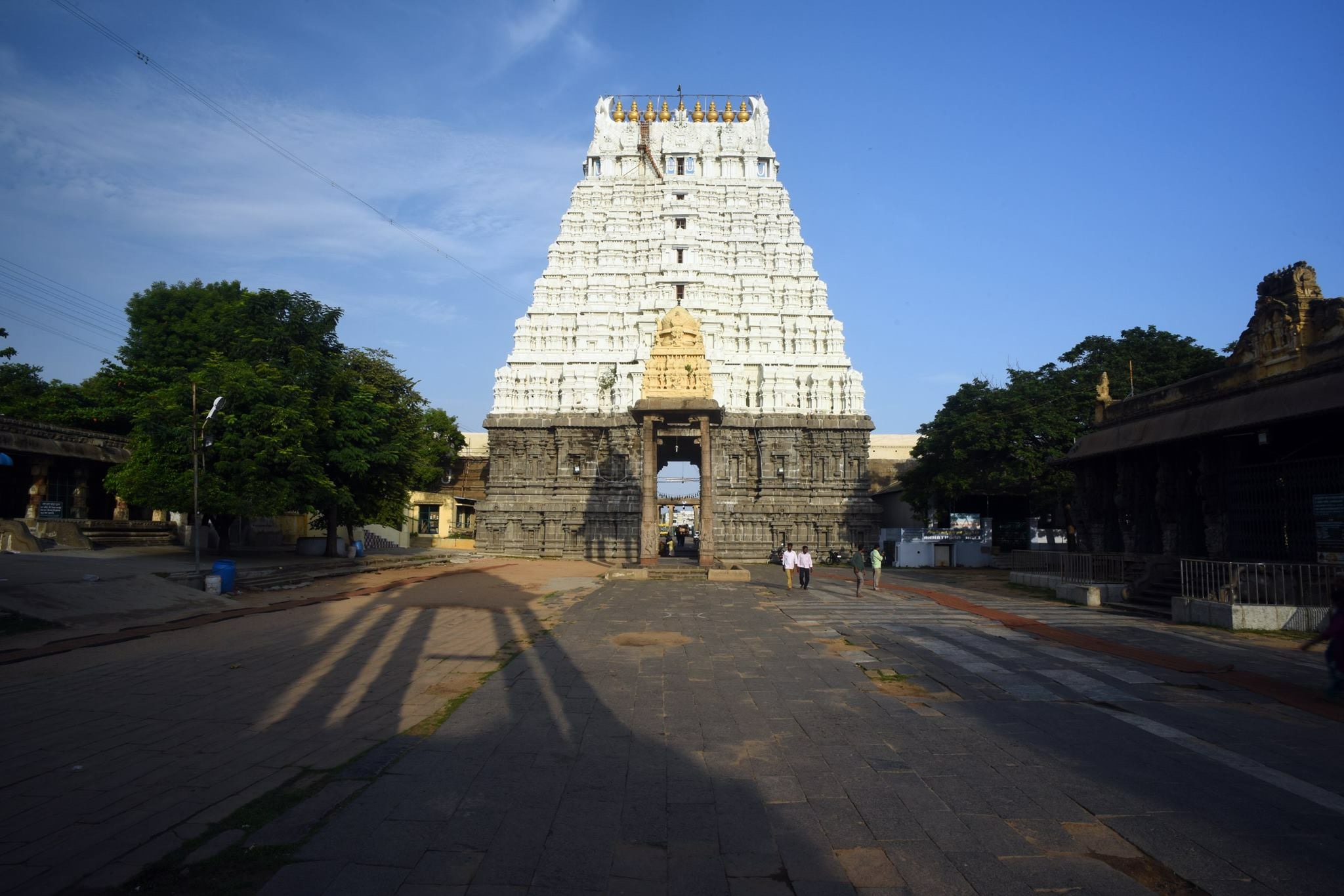
When Renovation Becomes Desecration: The Case of Sri Devarajaswamy Temple
When I first walked the Prakharas of the thousand-year-old Sri Devarajaswamy Temple in Kanchipuram, I was struck by one overwhelming feeling: awe. At the ingenuity of our ancestors, the precision of inscriptions on stone and walls, intricate carvings of rearing horsemen and yalis on granite, the vibrant colorful murals that somehow held their pigment through centuries, the sheer civilizational confidence embedded in every pillar with filigree-like carving and sikharas with beautiful stucco figures.
I was not yet struck by grief. It comes now, every time you visit one of these sites and watch with helplessness, as new age stone is laid replacing ancient paving stones, as pneumatic drills dug out earth inside Prakharas that once whispered with the hymns of Alwars and Acharyas, as centuries old fresco is covered with electrical boards and ancient inscriptions is painted over with modern oil pigments.
The Guardians Who Have Failed
This is not sentiment, it is a deep premonition of how our heritage is being slowly destroyed. India possesses an extraordinary and immensely varied civilisational inheritance, preserved in its ancient monuments, temples, and remains. They are enduring witnesses to our historical imagination, technological skill, and cultural continuity. Among these, temples occupy a particularly significant place. Many of them, with histories extending across kingdoms, are far greater than merely places of worship. They are repositories of knowledge, archives of ritual practice, centres of learning, treasuries of art and architecture, and living institutions through which the past continues to speak to the present. Yet, despite their immense historical and cultural value, many of these monuments and temple traditions are gradually slipping into neglect due to imprudent administration and rash maintenance.
The Constitution places a clear obligation on the State to protect and preserve India’s cultural and historical heritage. This duty is reflected in Article 49, under the Directive Principles of State Policy, which requires the State to safeguard monuments, places, and objects of national importance. In furtherance of this mandate, responsibility for heritage protection has been entrusted to institutions such as the Archaeological Survey of India (ASI), which administers more than 3,697 ancient monuments across the country. In Tamil Nadu, this responsibility is shared by the Tamil Nadu State Archaeology Department, established in 1961, and the Tamil Nadu Hindu Religious and Charitable Endowments Department (HR&CE), which acts as custodian of ancient temples, along with their funds, properties, articles, and lands.
However, these institutions have fallen catastrophically short. The ASI has been operating with an approach to restoration that by Parliamentary oversight has since been described as inadequate. A 2023 Standing Committee report chaired by Rajya Sabha MP V. Vijayasai Reddy found that restoration work at many ASI sites “does not align with the original design and beauty of the monument.”
The Madras High Court’s Intervention
The Madras High Court took the extraordinary step of suo motu action. WP 574 of 2015, registered after a “Silent Burial” report in The Hindu on 4 January 2015 became one of the most sweeping judicial pronouncements on India’s heritage governance in recent memory. Decided on 7 June 2021 by a bench comprising Justice R. Mahadevan and Justice P.D. Audikesavalu, the 225-page judgment documented in detail how Tamil Nadu’s temples, many over 2,000 years old, repositories of Dravidian art, epigraphy, music, dance, mural traditions, and living religious practice were being degraded. The judgement discusses the UNESCO Fact-Finding Mission for Tamil Nadu Temples, 2017, set up to examine ongoing and recently completed conservation works in major temples across Tamil Nadu. The report found serious flaws in the conservation process. It noted that the HR&CE Department lacked adequate capacity, qualified conservation experts, proper documentation systems, trained heritage contractors, and structured conservation procedures. Many officials were found to be managing technical conservation works despite not having the required expertise. The mission also observed that expert recommendations were often ignored at the ground level.
Most importantly, UNESCO flagged instances of poor-quality work, arbitrary interventions, demolition, and even severe damage to historic temple structures. It also pointed out the absence of Agama-based consultation, inadequate historical research, missing drawings and records, and the lack of Comprehensive Conservation Plans or Detailed Project Reports.
| The judgement refers- “both the central and state departments have failed in its efforts to safeguard the sites and remove the encroachments and illegal constructions in and around many temples and sites of archaeological importance…” |
It also held a mirror to the Hindu Religious and Charitable Endowment (HR&CE) Department, “Many temples constructed at least 2000 years ago or much before, recognised by UNESCO, are in ruins. Neither the Archaeology Department nor the HR&CE Department has shown interest to identify and protect them. This has also come to the advantage of the miscreants, who have laid their hands on the Idols. Some of the officials are only interested in reaping the benefits of their position in the department, without adhering to the task entrusted to them with devotion.”
The judgment mandated that no significant construction or renovation at a historically important temple could proceed without ASI consultation and involvement. A State Level Expert Committee (SLEC) was established to provide oversight. The Tamil Nadu Heritage Commission Act, 2012, was finally notified into force, twelve years late on 1 March 2024, making prior Heritage Commission approval mandatory for any work touching a heritage structure.
The Story of Varadaraja’s Abode: What Is Being Done to This Temple
Nowhere is the failure of the above bodies more evident than in one of India’s most significant temple complexes – the Varadaraja Perumal Temple also known as Sri Devarajaswamy Temple at Kancheepuram where HR&CE department has secured large infrastructure firms to undertake what are euphemistically called “pilgrimage infrastructure upgrades”. This development project carried out by the infrastructure firm L&T (Larsen & Toubro) has become a legally contested issue.
Several petitions have been filed by devotees, hereditary patrons, and stakeholders associated with the temple, who contend that the works being undertaken in the name of renovation are, in fact, causing incremental damage to the temple’s historic fabric. Among those opposing the project are Krishna Devaraya, a devotee of the temple and a lineal descendant of the Vijayanagara royal family credited with extensive patronage of this institution and the Thathadesikar Thiruvamsathar Sabha, an association of the Thathachariar community which has served as the traditional stakeholders of this temple for more than 800 years as documented in various inscriptions. They have raised serious concerns that the temple is being altered through repeated interventions that erode its antiquity, architectural integrity, and sacred character.
- A pedestrian ramp of over 65 steps crossing the 30-foot inner parikrama wall. This ramp routes devotees from Prakharam 3 directly to Prakharam 1, skipping Prakharam 2 entirely. The pedestrian ramp will cover over 65 steps constructed in such a manner that the said steps would cross the 30 ft wall inner parikrama of the temple. This however disrespects the traditions of the Agamic traditions followed by the temple. Such crossing of the walls are absolutely not permitted under any temple shastras. The purpose of the pedestrian bridge of over 65 steps is envisioned for crowd management and to evacuate pilgrims during emergencies. It must be noted that even in a Temple with maximum crowd like the Tirumala Venkateshwara Swami Temple, no such emergency steps have been constructed crossing the walls of the parikrama of the temple. Perhaps other crowd management measures like limited entry at a time and guards in the temple could achieve this purpose while preserving these age-old heritage structures.
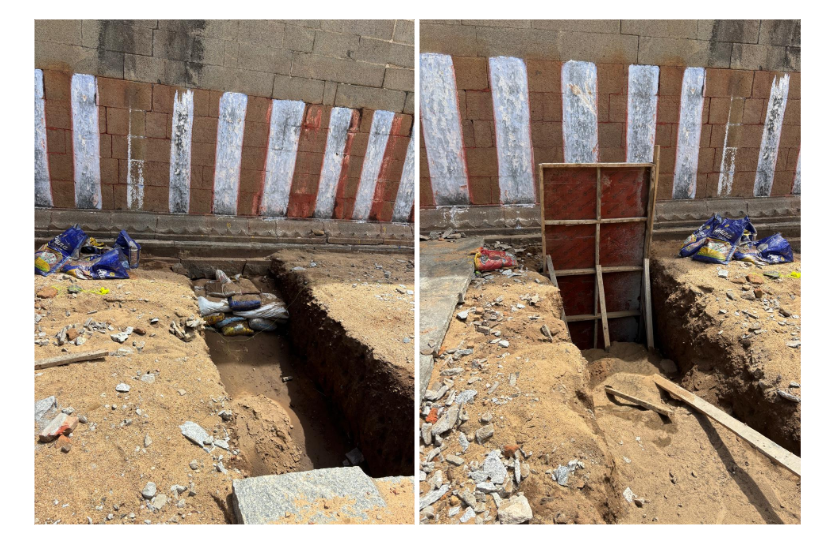
- A 12-foot pit was dug in the parikrama. During early construction works, the entire floor of the parikrama was removed and a 12-foot pit was dug around it, into which pile-like structures were embedded after removing the ancient tiles from the floor. This happened despite the Executive Officer’s affidavit before the court in WP 22177/2025 claiming that “no heritage structure is being disturbed.” That affidavit statement and the 12-foot pit are directly contradictory.

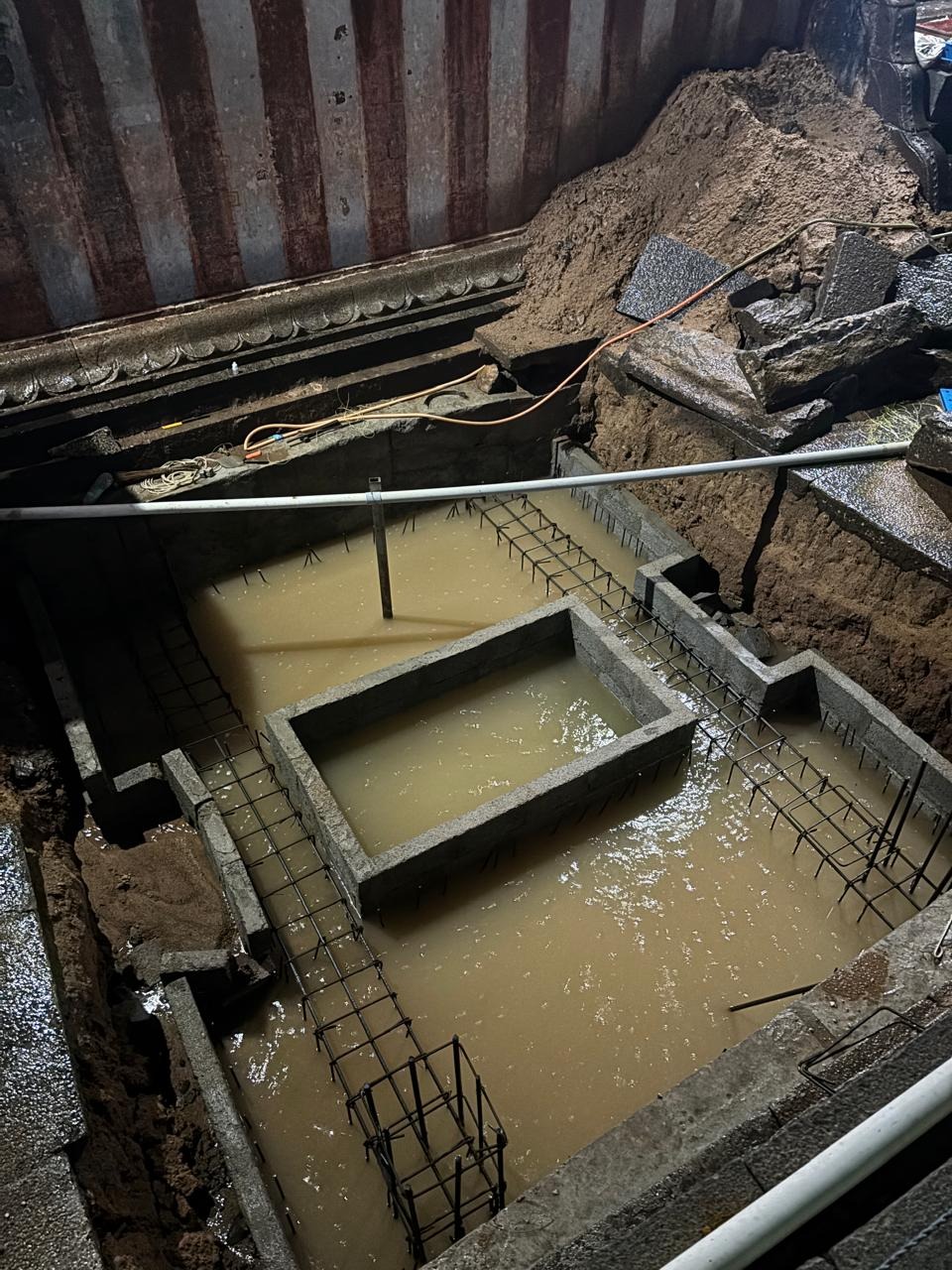
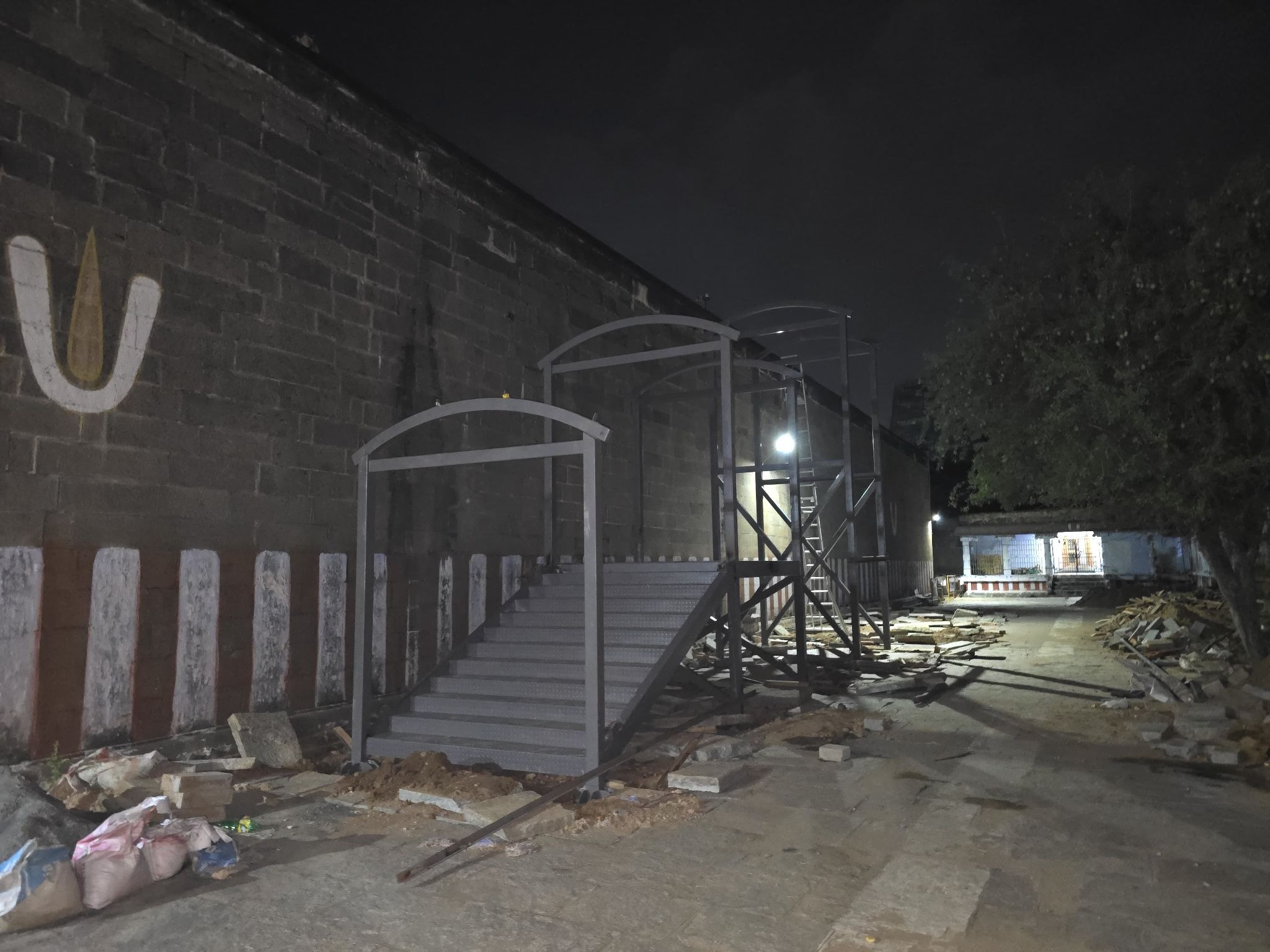
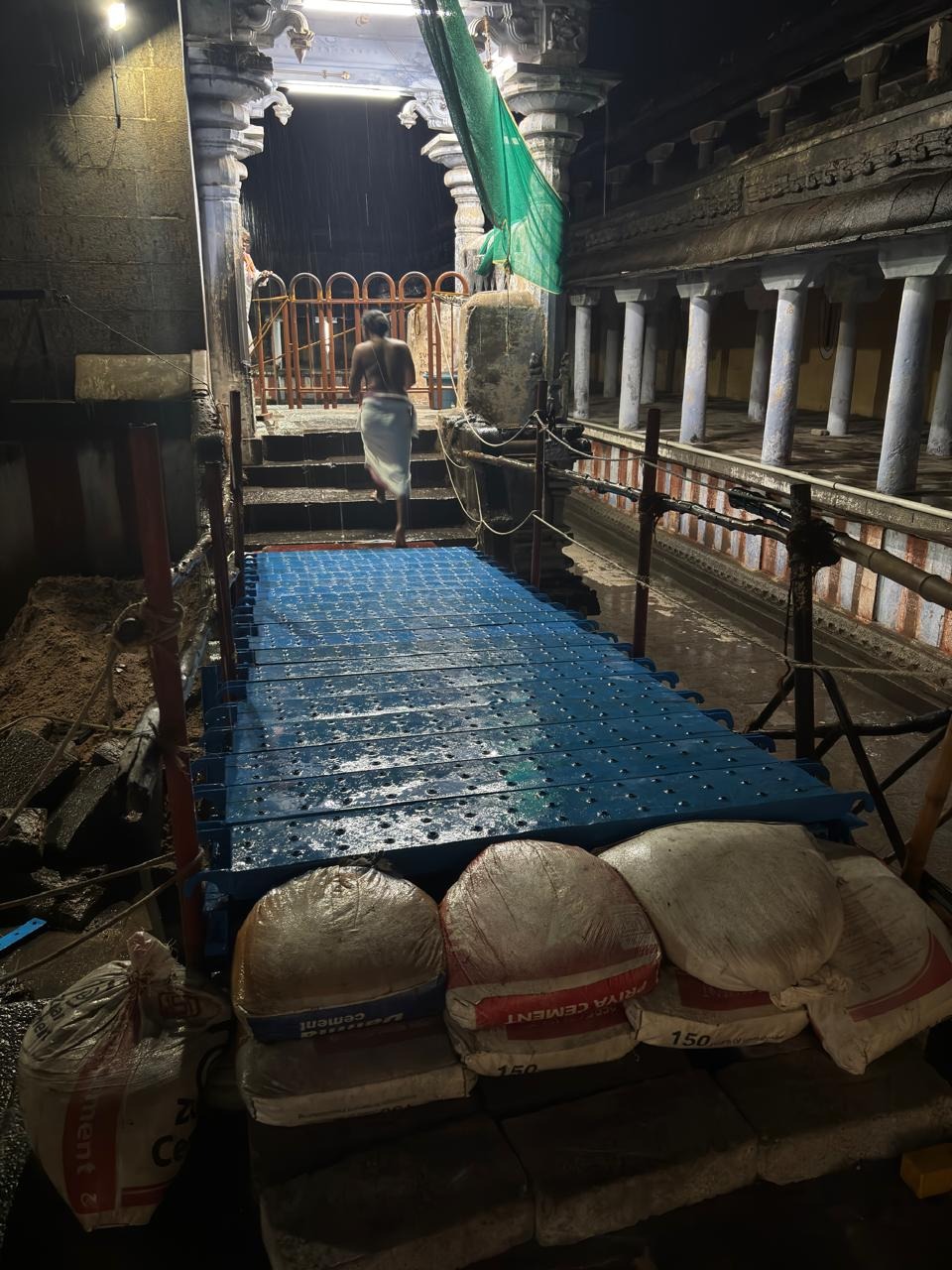
This ramp caused irreparable damage to the ancient stone tiles in the 2nd Prakhara (Giri Pradakshina Prakhara) containing inscriptions of Vijayanagara emperor Venkatapati Deva Raya which were dug up for laying concrete foundation for pedestrian bridge as shown in the top most image.
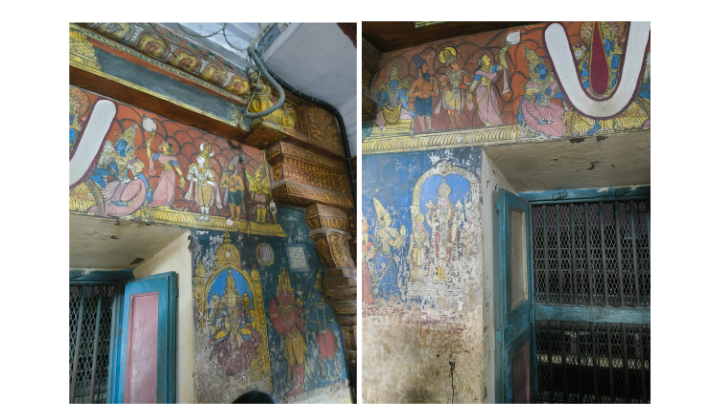
- A window in the first Prakharam is being converted into a doorway. The window in question has, on either side of its frame, intact Vijayanagara-era murals. The murals are painted deities. To open the wall into a doorway, the murals on one or both sides of the window frame will be destroyed or significantly compromised. No mural documentation was completed before works began. Already the said murals have been desecrated by the HRCE through the painting of ‘Vadakalai Namam’ with acrylic paints over them. During the course of the hearing, the HRCE tried to use this as a justification for disregarding the sanctity of these murals.
- The six sacred steps at the garbhagriha have been covered with an artificial wooden platform. This covering converts the six steps into ten is a direct violation of the ‘Jayakhya Samhita’s’ prescription (see Glossary). The old granite steps with inscriptions are now replaced with slippery wood. It has now become difficult to carry the Utsavar Murthy (the processional deity) up these slippery wooden steps to the sanctum in the traditional manner, due to the sheer weight of the millennia old processional deity which will now be carried over slippery wooden steps instead of the hard stone steps providing the essential grip.
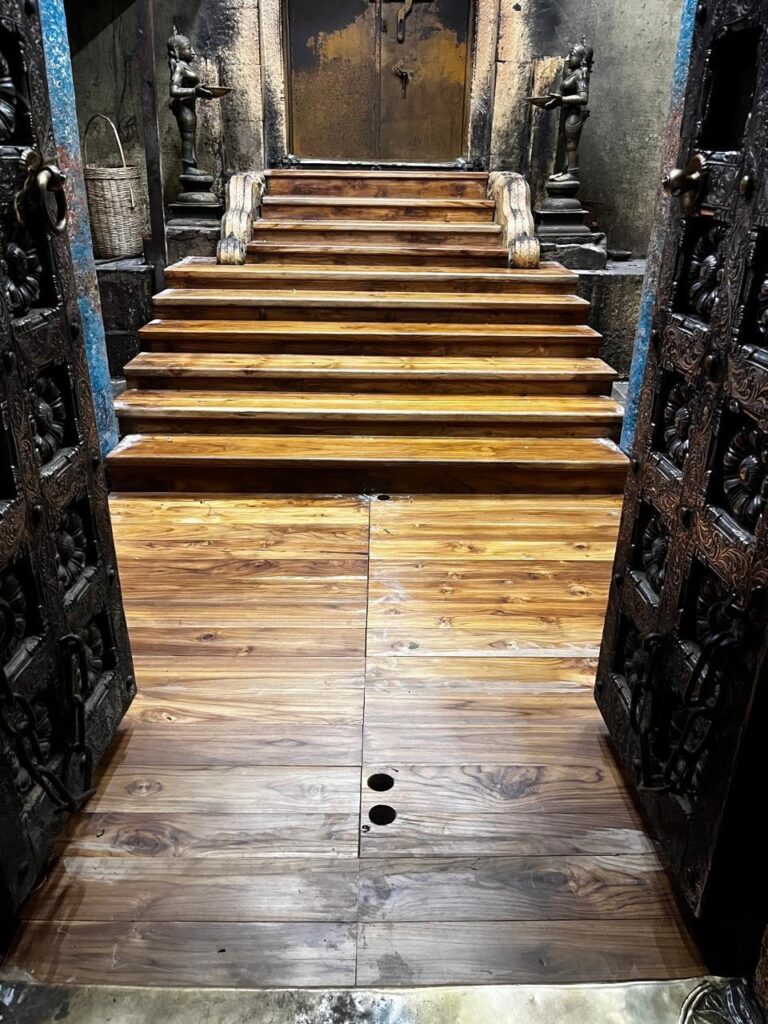
The wooden cover over the 6 steps leading to the garbhagriha portraying the shadakshara mantra, increasing the number of steps to 10 thus dismantling their religious significance
The original steps are mentioned in the Hashtigiri Mahatmayam chapter of the Jayakya Samhita of Pancharatra Agama which mentions the sthala purana and sacred architecture of the temple as seen below:
“Verse 129- He built six steps which are in memory of the shadakshara mantra of Lord Vishnu (who is the husband of Lakshmi).”
- A false ceiling is proposed to be installed inside the temple. This false ceiling would cover the ceiling murals, Vijayanagara-era paintings that have survived five centuries. The stated justification is unclear. The conservation consequence is not: murals covered by modern false ceilings are denied light, air circulation, and visual monitoring. Salt efflorescence, biological growth, and mechanical stress from the ceiling structure itself cause irreversible damage to plaster and pigment. Conservation protocols like the Venice Charter (1964) standard prohibits covering original surfaces with new interventions that prevent monitoring and accelerate decay.
- The ancient golden lizard has been repositioned and replaced. The golden lizards at the Varadaraja Perumal temple are among its most famous features installed, according to temple legend, by Indra himself. Their position on the ceiling is fixed by Agamic tradition and sthala purana. The Executive Officer, without consulting any Pancharatra Agamic scholar and without SLEC approval, has had the original lizard lowered to a touchable height and replaced with a larger one because the devotees want to touch it. A special darshan counter has been opened for the purpose with a fee attached (a revenue source for the HR&CE). An object of Agamic significance, built in the original structure of the temple, has been physically altered for revenue optimisation.
Irreversible Damage in the Name of Development
This rampant construction in the temple has done irreversible damage- in the eastern gopuram new stones have been overlaid above existing heritage stones, granite tiles in the fourth Prakharam has been extensively damaged due to heavy vehicle movements and the fort wall near Thayar Shrine bulged due to excavation of near by site.
It is a sad state of affairs that these renovation works are being carried out in such a manner that degrades the original structure of the temple, lay ruin to the murals and fresco of Vijayanagara era, and ancient granite stone with 500+ years of inscription of a temple which is one of the 108 Divya Desams, that has carried civilisations from the Cholas in the 11th century, the Pandyas, Vijayanagara emperors, and the Nayakas of Madurai and Thanjavur, each dynasty leaving its architectural signature. The 23-acre complex of extraordinary stratified complexity: three Prakharams (Azhwar Prakharam, Madai Palli Prakharam, and Thiru Malai Prakharam), 32 shrines, 19 vimanams, and 389 pillared halls, most adorned with the signature yali sculptures of Dravidian temple craft and the twin gopurams, the East at 125 feet, the West at 92.5 feet are landmarks of the Kancheepuram skyline, is being subjected to this.
The Venice Charter and the Principle of Minimal Intervention
The state Government Order classifies structures over a century old as heritage monuments and mandates that all works on such structures conform to the Venice Charter, the international conservation standard that requires reversibility of all interventions, compatibility of materials, minimal interference, and preservation of authenticity. Every single work at the Devarajaswamy Temple violates Venice Charter principles. The works are irreversible. The materials are incompatible. The interventions are maximal.
| The Venice Charter (1964) is the international gold standard for heritage conservation that mandates, among other things: 1. Reversibility of all interventions (nothing permanent that cannot be undone) 2. Compatibility of materials (no alien materials like cement on ancient lime-mortar structures) 3. Minimal intervention (do only what is necessary) 4. Authenticity preservation (do not alter the original fabric) |
WP 574/2015 Madras High Court, judgment mandated that no significant renovation can proceed without ASI consultation and SLEC oversight, with the archaeological department head as a compulsory participant. For the construction approvals in this temple Archaeological head was absent. Tamil Nadu Heritage Commission Act, 2009 (enforced 01.03.2024) makes Heritage Commission approval mandatory for any development affecting a listed heritage structure. The Heritage Commission was not referred to at all.
What Actually Needs Preservation
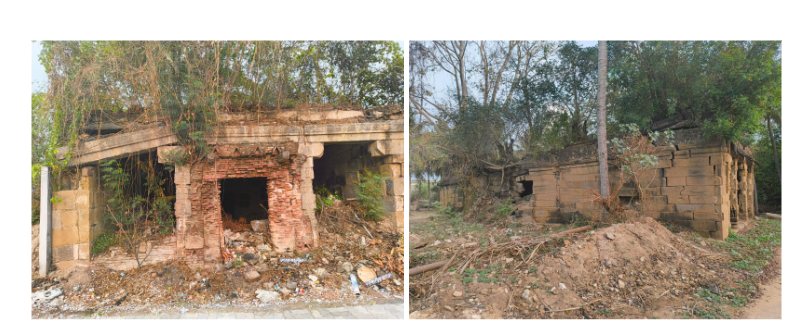
There is an immediate need to rethink the renovation work going on in the Sri Devarajaswamy Temple, the temple is being renovated where it is not needed (expansive pedestrian bridges replacing old structure, using cement and concrete instead of lime and mortar) when the original shrines of Alwars in the fourth Prakhara are in desperate need of preservation (see images below) and the paintings and murals of the temple that depicts scenes from the sthalapurana of the temple, Alwars and Acharyas and the presiding deities of sacred Vishnu temples. These paintings of the Vijayanagar times done in ‘fresco secco’ technique are dated to be from the beginning of the 16th century yet are now covered by electrical boards- such is the maintenance and upgradation (with the budget of 30,95,81,000/-) of the HR&CE department.
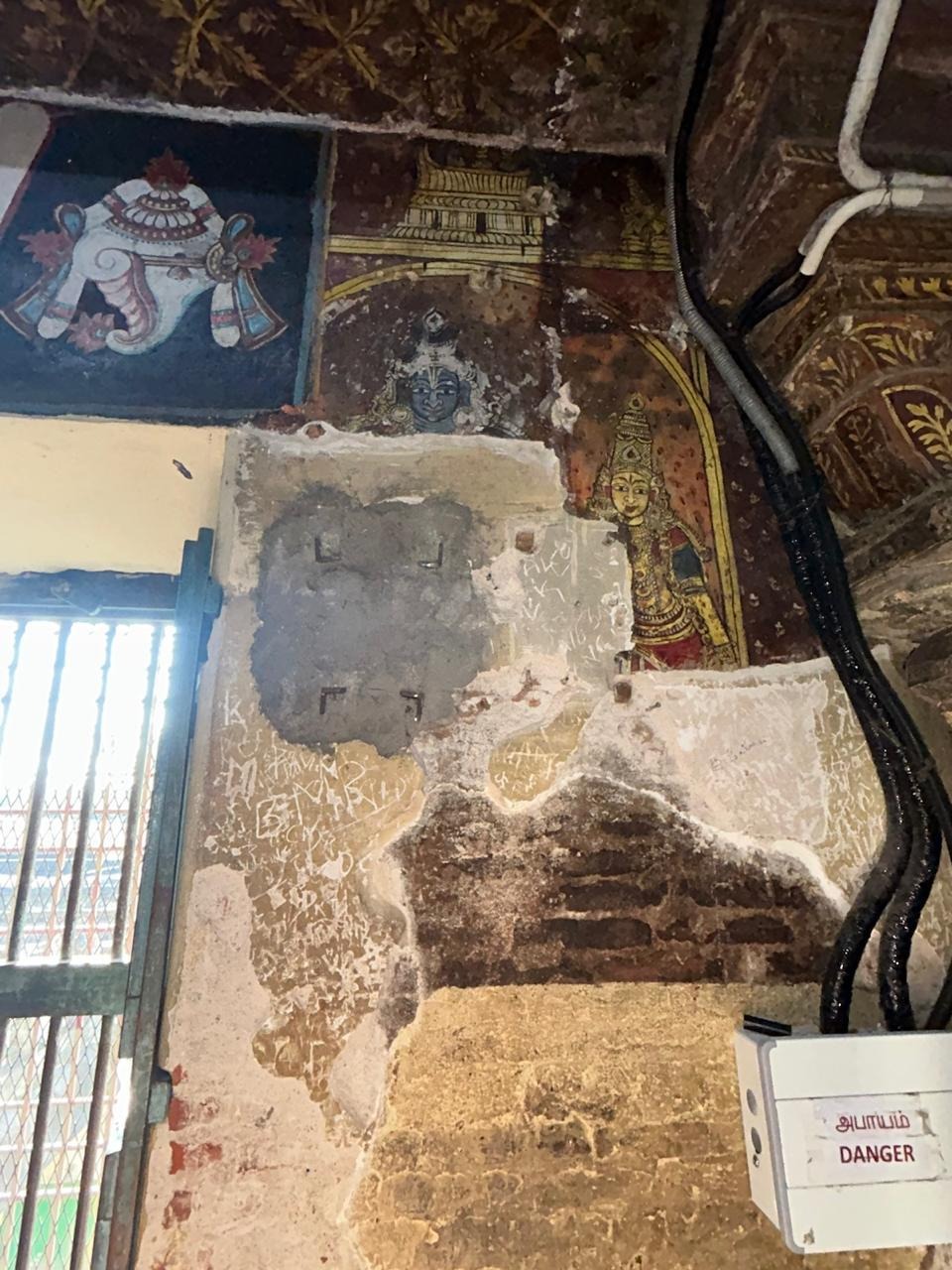
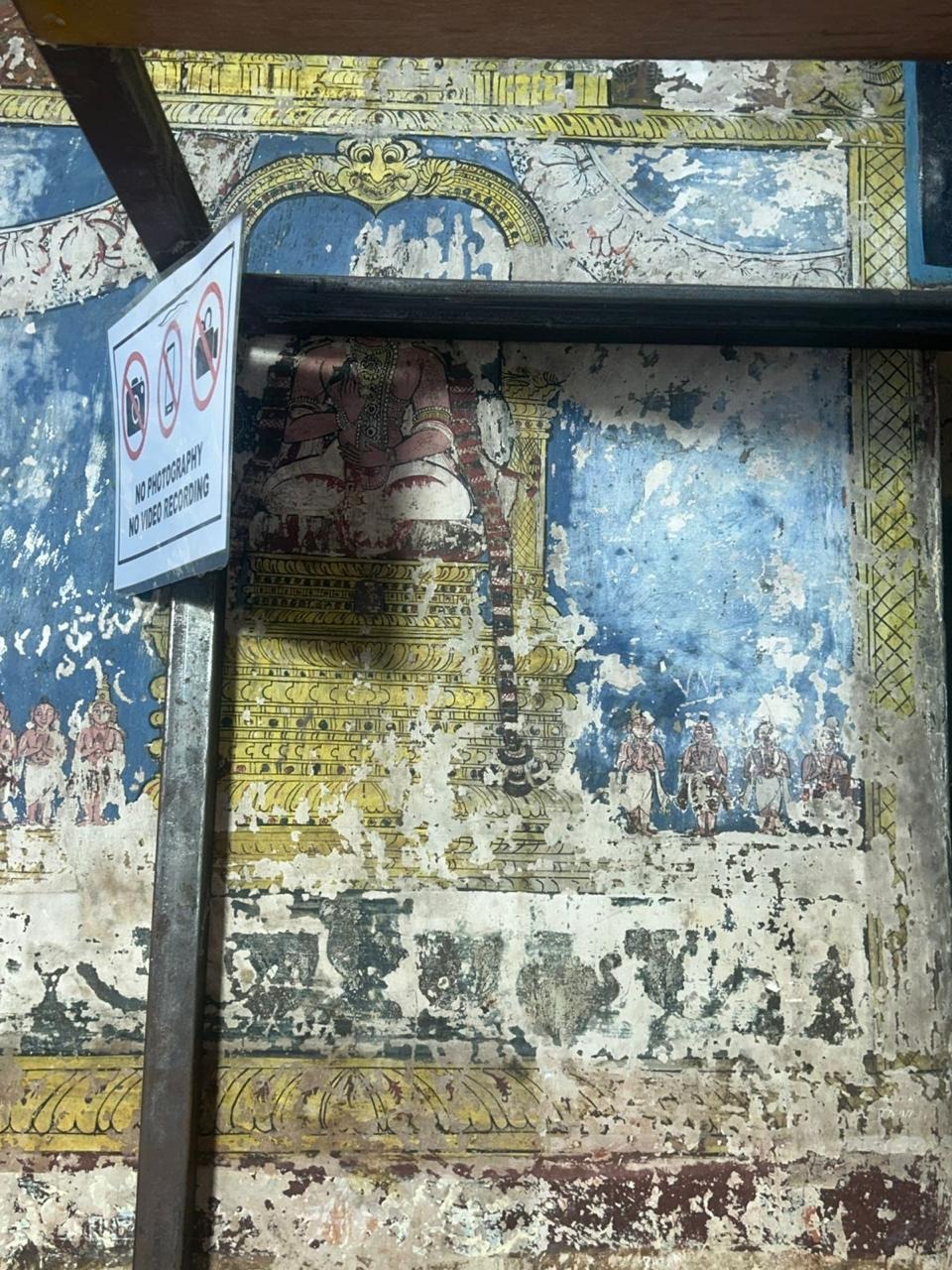
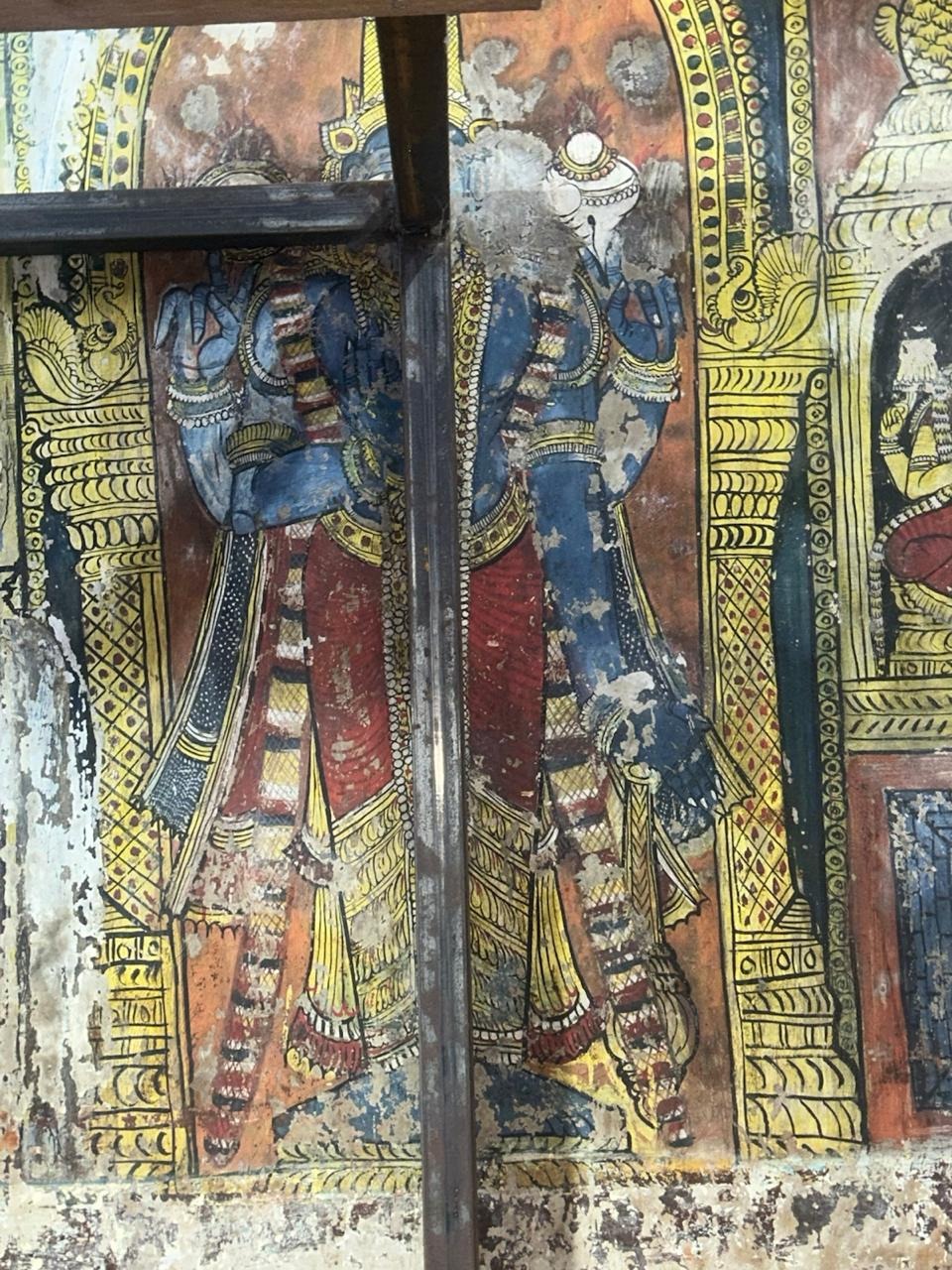
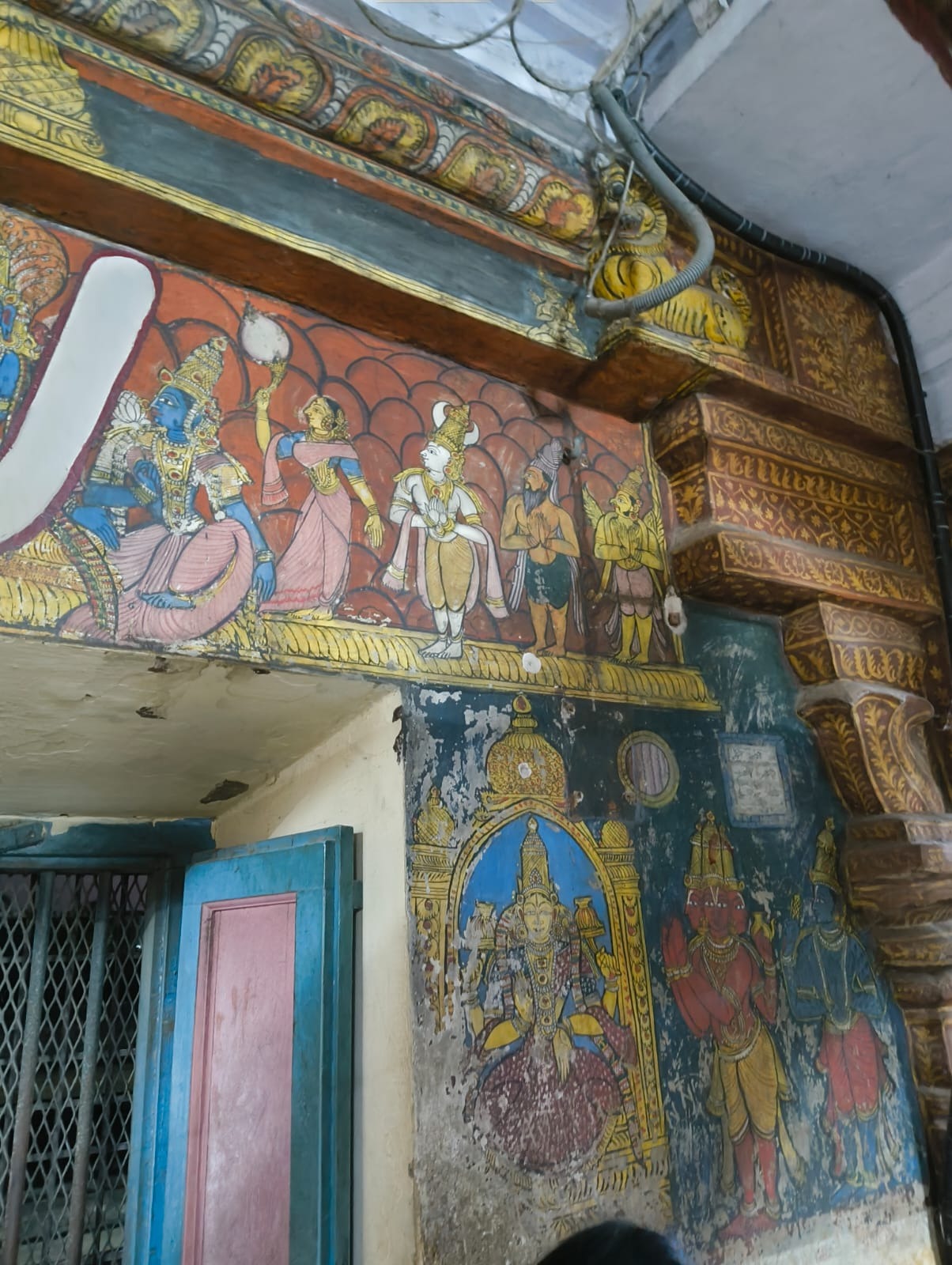
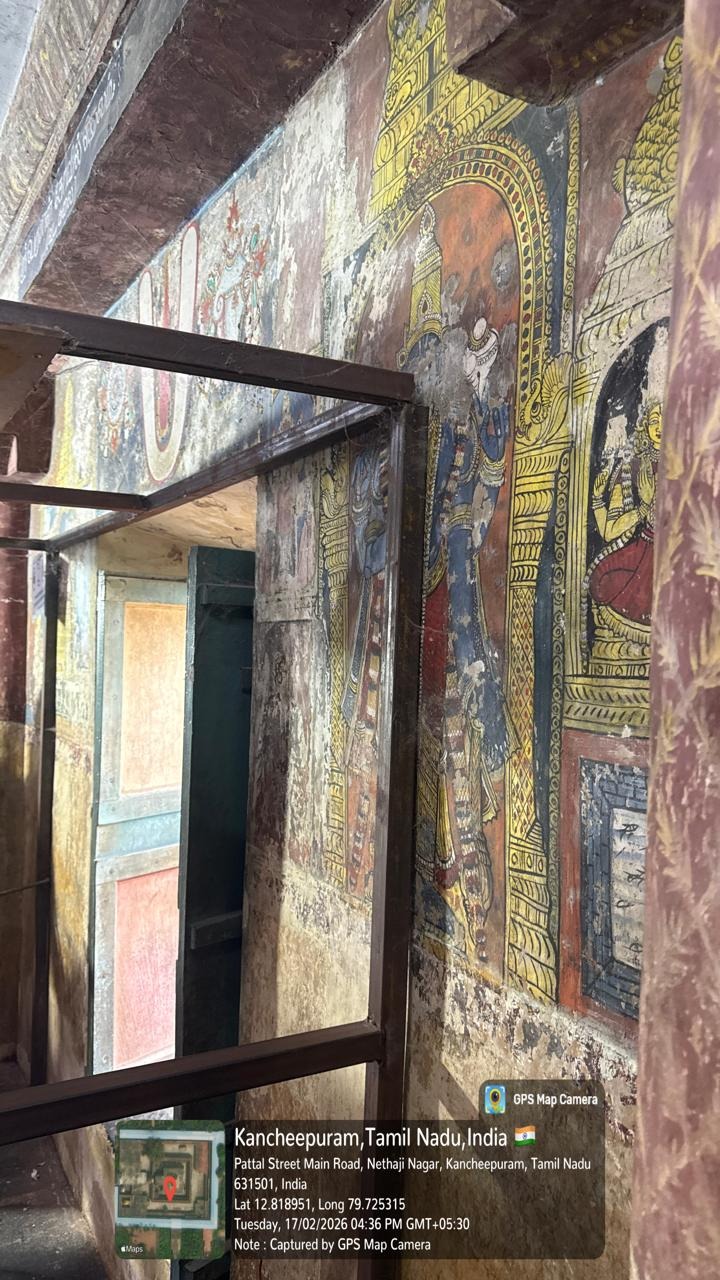
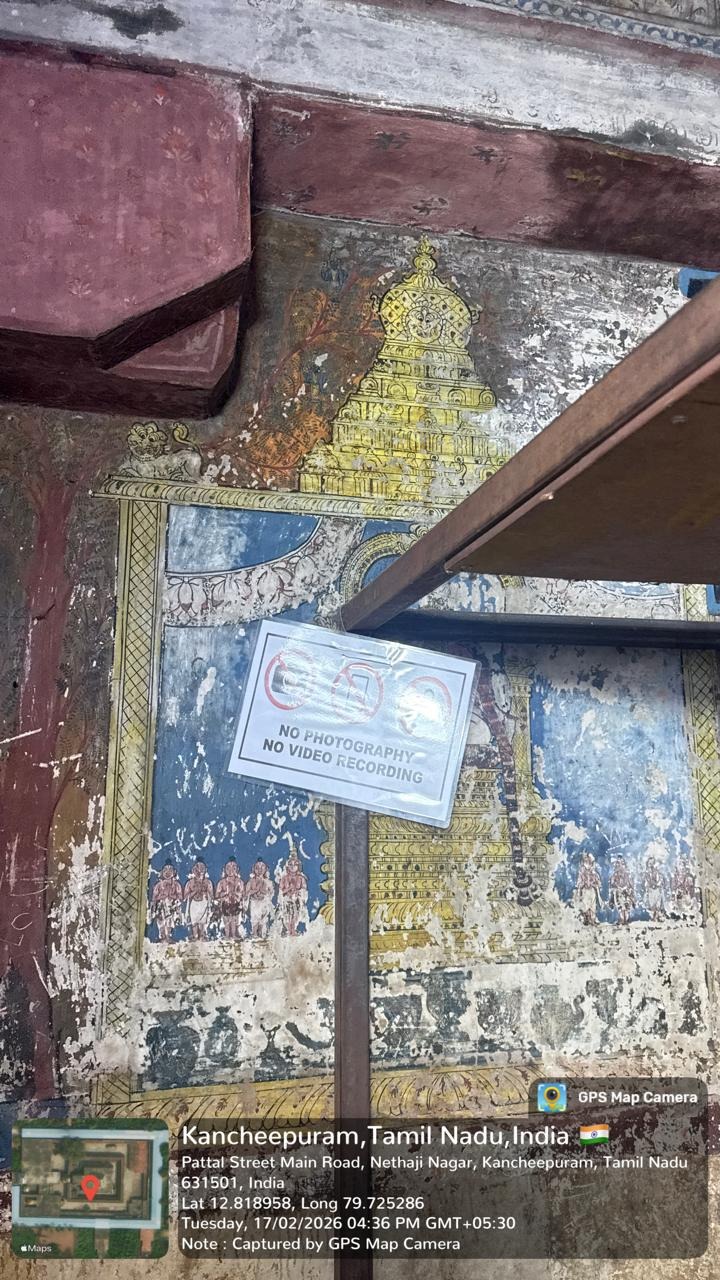
Ancient murals damaged by electrical boards and modern construction
Glossary
- Acharyas: Spiritual teachers and preceptors who transmit religious knowledge, scriptural interpretation, ritual discipline, and philosophical tradition. In the Vaishnava tradition, Acharyas played a major role in preserving theology, temple practice, and devotional literature.
- Agama: A body of sacred texts that lays down rules for temple construction, iconography, rituals, worship, festivals, priestly duties, and the daily functioning of temples. In Vaishnava temples, Pancharatra and Vaikhanasa Agamas are especially important.
- Alwars: Tamil Vaishnava poet-saints, traditionally dated between the early medieval period, whose devotional hymns in praise of Vishnu and his sacred shrines form the Nalayira Divya Prabandham. Their compositions are central to the Sri Vaishnava tradition.
- Divya Desams: The 108 sacred Vishnu temples celebrated in the hymns of the Alwars. These temples hold special importance in the Sri Vaishnava tradition and are considered among the most revered Vaishnava pilgrimage sites.
- Fresco-secco technique: A mural painting technique in which pigments are applied on dry plaster, unlike true fresco, where pigments are applied on wet plaster. Many South Indian temple murals, including those from the Vijayanagara period, were executed using this method.
- Garbhagriha: The innermost sanctum of a Hindu temple where the principal deity is enshrined. It is the most sacred space of the temple and is usually accessible only to authorised priests.
- Gopuram: A monumental entrance tower of a South Indian temple, usually richly decorated with sculptures, stucco figures, and mythological imagery. Gopurams often mark the gateways into successive temple enclosures.
- Jayakhya Samhita: The Jayākhyasaṃhitā is an important early Pancharatra Agama text associated with the Vaishnava tradition. It prescribes ritual, theological, ethical, and spiritual practices for devotees, including modes of worship, temple practice, and the pursuit of liberation. It is traditionally regarded as one of the three major Pancharatra Samhitas, along with the Sattvata Samhita and Paushkara Samhita.
- Prakaram / Prakara: An enclosed circumambulatory passage or courtyard around the sanctum or inner shrine of a temple. Large South Indian temples often have multiple prakarams, through which devotees move in ritual circumambulation.
- Sthala Purana: A sacred traditional account associated with a particular temple or holy site. It narrates the origin, legends, miracles, deities, rituals, and religious significance of that sacred place.
- Utsavar Murthy: The processional image of the deity, usually made of metal, which is taken out of the sanctum during festivals, rituals, and temple processions. Unlike the fixed main deity, the Utsavar Murthy is ritually mobile.
- Vadakalai Namam: A distinctive Vaishnava forehead mark associated with the Vadakalai sub-tradition of Sri Vaishnavism. It usually takes the form of a white “U” or vertical mark with a central red or yellow line, symbolising the feet of Vishnu and the presence of Lakshmi.
- Yali sculptures: Sculptures of mythical composite creatures, often combining features of lions, elephants, horses, and other animals. Yalis are common in South Indian temple architecture, especially on pillars, where they symbolise strength, protection, and royal power.
References:
Legal references:
- Suo Motu WP No. 574/2015, Madras High Court (Judgment dated 07.06.2021)
- WP No. 44347/2025 Sri Krishna Devaraya v. HR&CE Commissioner, Kancheepuram (Order dated 23.02.2026)
- WP No. 22177/2025; WP No. 34810/2023
Other:
- The Jayakhya Samhita verses cited, agamic text of the Varadaraja Perumal Temple.
- Standing Committee on Transport, Tourism and Culture. (2023, September 21). 359th report: Functioning of Archaeological Survey of India (359th Report). Rajya Sabha Secretariat, Parliament of India.
- Raman, K. V. (1975). Sri Varadarajaswami Temple, Kanchi: A study of its history, art and architecture. Abhinav Publications.
Sunita
Govt has forgotten the difference between renovation and preservation.
Ajaykumar
yes many of our heritage gems are now covered by cement and paint. very sad to see these