A Reassessment of Pandya Sovereignty Status in the Early Twelfth Century
The general view among the historians is that post the defeat of Chozhan thalai konda Vira Pandyan by Chozha prince Aditya Karikala, Pandyas ceased to exist as an independent power till Maravarman Sundarapandya defeated the Chozha empire in early 13th century. All attempts made by Pandyas to reconquer their territory have been treated as feeble attempts put down by the Chozha empire with some Pandyan rulers being treated as vassals of Chozha empire in 12th century.
This opinion seems to be a result of an unconscious bias in favor of the formidable Chozha empire of the era. Such bias has made the historians ignore a very important inscription of one Manabharana Pandya in Srirangam and 2 other inscriptions from Sri Lanka. This has resulted in a wrong opinion about the status of Jatavarman Srivallabha, a Pandyan ruler of the 12th century whose stone inscriptions are found throughout the erstwhile Pandyan lands.
The purpose of the present article is to set the record straight by a proper study of the Srirangam inscription of Manabharana, Lankan inscription of Kulottunga I’s daughter, Culavamsa and the inscriptions of Jatavarman Srivallabha. It is the view of this author that Pandyans reclaimed their independence before 1120 CE and continued be mostly free of Chozha supremacy for the next few decades. The state of affairs turned for the worse in the reign of Kulottunga III’s reign when the internecine struggle among Pandyan rulers enabled the Chozha emperor to interfere decisively in the internal affairs of the Pandyan kingdom and place his own vassal on the throne.
The Srirangam Inscription of Manabharana Pandya: Evidence of Independent Authority
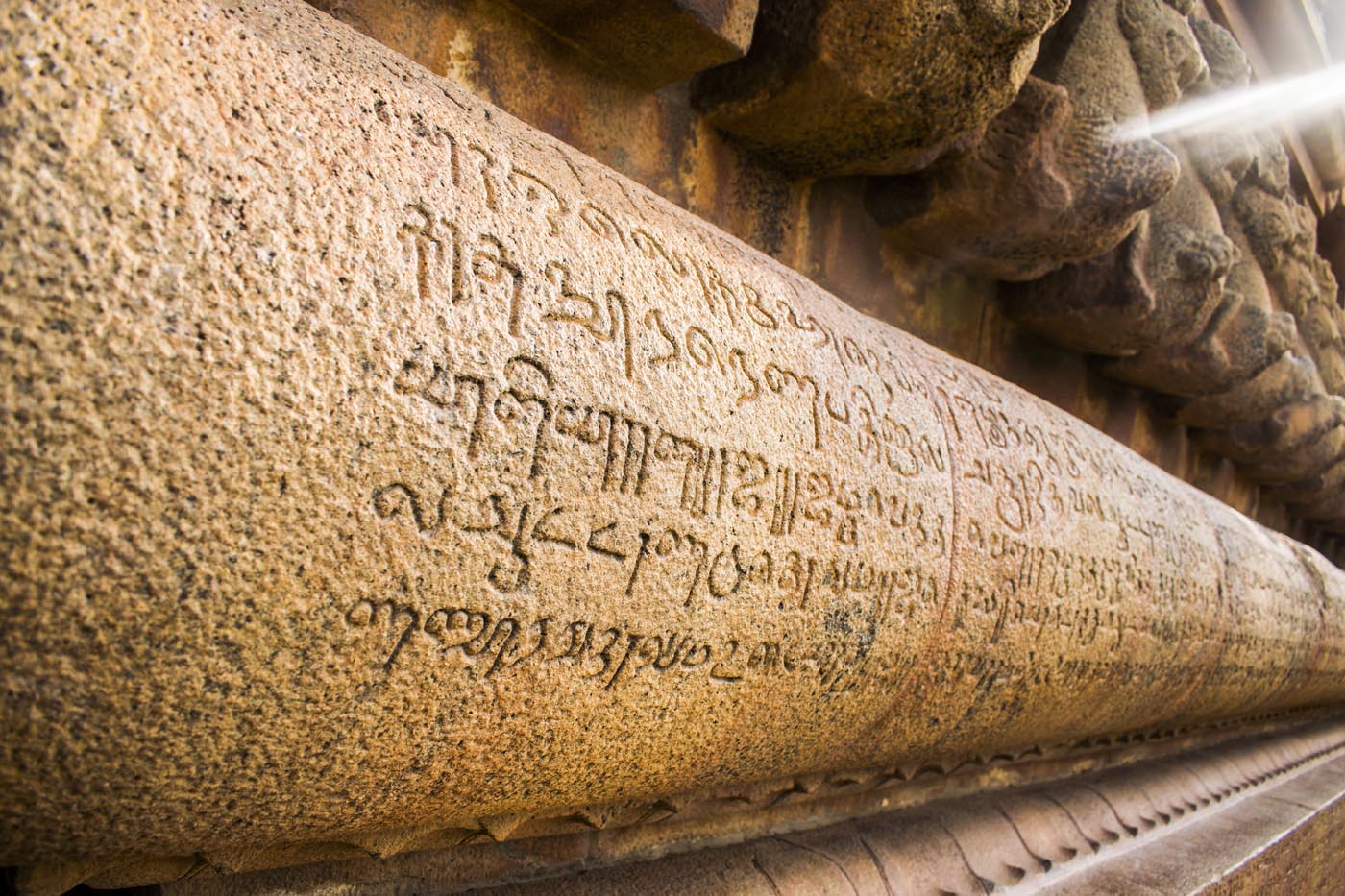
The key inscription to be considered first is the Srirangam inscription of Manabharana Pandya. This inscription mentions Manabharana Pandya and Vira Kavi Alupendra as the rulers. Pattamahadevi and Kittideva are the donors in this inscription. The relationship between donors and the rulers are not clear due to damages in the inscription. A later Alupa queen, Ballamahadevi, is described herself as the descendant of Manabharaneshvaradeva in a 1203 CE inscription found at Kenjuru near Udupi. Hence, it is possible that the Pattamahadevi mentioned here is a daughter of Manabharana and married to Vira Kavi Alupendra of Alupa dynasty.
Re-examining the Identification of Manabharana: Problems in Earlier Interpretations
The decipherer of this inscription, Mr KG Krishnan, has made certain wrong inferences about the persona involved. He has presumed that Manabharana mentioned in the inscription is the son of Jatavarman Srivallabha – whose reign started around 1120-22CE. He also states that this Manabharana is the nephew of the Lankan king Vijayabahu and that Manabharana had become uparaja after the death of Vijayabahu in 1111CE. There are multiple problems with this identification. It is true that Jatavarman Srivallabha Pandya had a son named Manabharana but this inscription belongs to the tenth year of Jatavarman’s reign which corresponds to 1130-32CE. Whereas the nephew of Vijayabahu, Manabharana, died in early 1120s CE. Culavamsa is categorical in stating that Manabharana died soon after the birth of his son, Parakramabahu I, the Great. Parakramabahu I was born in the early 1120s CE. Hence, it is not possible that the Manabharana who is mentioned as alive in 1130-32CE could be the nephew of Vijayabahu. For the sake of clarity, we shall mention the elder brother of Kitti Sirimegha and Srivallabha as Manabharana I while the son of Srivallabha shall be mentioned as Manabharana II.
Sri Lankan Evidence: The Role of Manabharana I and His Brothers
Manabharana I, the nephew of Vijayabahu, had 2 younger brothers – Kitti Sirimegha and Srivallabha. The brothers ruled Rohana and Dakkhinadesa portions of Sri Lanka of which the former was split between Kitti Sirimegha and Srivallabha while the latter was ruled by Manabharana I with the title Virabahu. Culavamsa states that Srivallabha had a son, Manabharana II. Culavamsa states that Parakramabahu I was born to Manabharana I, the eldest brother who was titled Virabahu, after his austerities in a temple of Indra.
Virabahu alias Manabharana I performed several Vedic sacrifices when his wife became pregnant with his son, Parakramabahu I. While he did ask the Bhikkhus to recite their Sutras, he also kept to his Hindu rituals which were performed by Brahmanas who were well versed in Vedas and Vedangas. Manabharana I died shortly after annaprashanam of Parakramabahu I. We know that annaprashanam is done when the child is 6 months old as per Grhya sutras. We may presume that Parakramabahu’s father died within a year of his birth.
The Restoration of Pandya Rule Under Jatavarman Srivallabha
Post the death of Manabharana I, Kitti Sirimegha took over rulership of Dakkhinadesa province which was ruled by his elder brother while the entire Rohana was handed over to Srivallabha. We have noted above that the reign of Jatavarman Srivallabha in Pandyan country started around 1120-22 CE. This suggests that Manabharana I had reconquered Madurai and the Pandyan territories before his death. Post his death, the Pandyan lands were ruled by his brother Srivallabha with the title, Jatavarman Srivallabha.
Kulottunga’s Daughter: Evidence of Dynastic Alliances
A stone inscription from Sri Lanka gives an interesting information regarding the rise of the Pandya dynasty under Manabharana. It mentions about a Chozha princess, Chundhamalli Azhvar as a daughter of Kulottunga Chozha Deva and wife of Pandiyan Virapperumal. The inscription is dated as belonging to the 8th year of Jayabahu’s reign which translates to 1118CE – around the same time when Vikrama Chozha was anointed as the Chozha Yuvaraja replacing his brother Parantaka. This inscription seems to suggest that a marital union happened between the Chozha and Pandya houses – which was unthinkable till then. The circumstances behind this marriage are closely related to the internal squabble in Chozha royal family which was utilized by Hoysalas and Pandyas.
Internal Conflict and the weakening of the Chozha Empire
Vikrama Chozha was married to a Hoysala princess (who became mother of Kulottunga Chozha II). Hoysalas seem to have invaded Chozha lands in support of their son-in-law’s claim to Chozha throne. Kulottunga I had initially anointed his son Parantakadeva as his successor in 1111-12CE but his other son, Vikrama, seems to have revolted against his brother and became the successor to the throne in 1118CE. Hoysala Vishnuvardhana appears to have supported Vikrama’s efforts to capture the Chozha throne. That the Hoysala invasion was not merely restricted to Talakadu but had entered core Chozha territories is established by Aduthurai inscription which states that the murtis of the temple at Aduthurai were taken away to Dvarasamudra and that they were ransomed back (neDu attam kuduttu) by local Pallis in the 4th year of Vikrama Chozha’s reign. Hoysala presence in the Chozha heartland is indeed confirmed by this inscription which further substantiates the Srirangam inscription mentioned above – where we see the presence of Alupas and Pandyas in Srirangam. It is now clear that during the last years of Kulottunga Chozha I’s reign, Hoysalas, Alupas and Pandyas had invaded Chozha territory taking advantage of the internal squabbles in the Chozha royal family. Hoysala Vishnuvardhana along with his ally Alupa Vira Kavi had invaded Chozha empire to place Vikrama Chozha on the throne of the empire. Pandyas seem to have invaded the empire around the same time and they managed to reconquer their ancestral lands. Pandya Manabharana I managed to land himself a Chozha princess as wife – most probably as a peace offering by Vikrama who must have cultivated close friendship with the neighboring rulers to strengthen his position within the Chozha empire.
Pandya Independence Before 1120 CE
The inscriptions of Jatavarma Srivallabha are found throughout the Pandyan territory and it is seen that he had reigned for 27 years which places his reign circa 1122CE to 1149CE. In these inscriptions, he is normally titled as Tribhuvanachakravarti and no mention is made of any Chozha overlord in any inscription. This can be taken to mean that Pandyan kingdom had remained relatively independent of any Chozha suzerainty during this period. The resurgence of Pandyan kingdom in the first half of the 12th century is acknowledged herein.
References :
- Epigraphia Indica, Vol. XXXVIII. pp. 225–230.
- Epigraphia Indica, Vol. XXXVIII. pp. 226–227.
- Epigraphia Indica, Vol. XXXVIII. p. 227.
- South Indian Inscriptions, Vol. XIV. No. 225.
- South Indian Inscriptions, Vol. XIV. Nos. 198–261.
- Culavamsa, Vol. I. Pali Text Society, London, 1929, pp. 226–238.
- Epigraphia Zeylanica, Vol. III. pp. 311–312.
- Moovarula: Kulottunga Chozhan Ula. Kalakshetra Adyar, 1946, Verses 29–31, pp. 73–74.
- Epigraphia Indica, Vol. XXXII. “Two Inscriptions of Parantaka, Year 9,” pp. 190–195.
- Avanam, Vol. 18. July 2007, pp. 84–86.